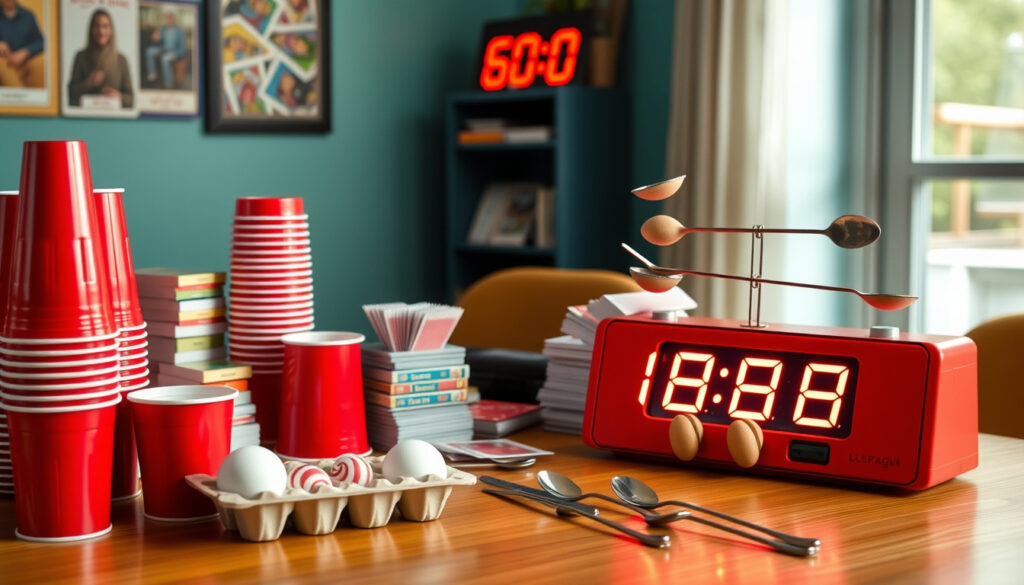
Minute to Win It Games – 60-Second Challenges for All Ages
Minute to win it games have transformed casual gatherings into high-energy competitions that keep participants on the edge of their seats. These 60-second challenges use everyday household items, requiring nothing more than creativity and quick reflexes to complete. Whether planning a birthday celebration, family game night, or office party, the format delivers instant engagement without demanding elaborate preparation or expensive equipment.
The concept originated from an NBC television show hosted by Guy Fieri, where contestants attempted increasingly difficult tasks within a strict one-minute window. Since then, the format has escaped studio boundaries and entered homes, classrooms, and workplaces worldwide. Players young and old have embraced the simple premise: complete the challenge, beat the clock, and claim victory.
Understanding how these games function and which variations suit specific audiences helps hosts deliver memorable experiences. The following guide examines game mechanics, popular challenges organized by audience and setting, and practical advice for organizing successful events.
What Are Minute to Win It Games?
Minute to win it games consist of timed challenges designed to be completed within exactly 60 seconds. Participants use common household items rather than specialized equipment, making the format accessible to virtually anyone. The games test dexterity, speed, knowledge, and coordination through simple but often surprisingly difficult tasks.
60-second challenges using everyday household items
1 to 20+ participants in solo, paired, or team formats
Household staples including cups, paper plates, string, and balloons
Parties, office events, family nights, and group gatherings
How Do You Play Minute to Win It?
Three primary formats accommodate different group sizes and preferences. The player versus clock format involves a single participant competing against the timer to complete a challenge and win a prize. This works particularly well when rotating different players through each game, ensuring everyone receives equal screen time.
Head-to-head competition places two players side by side attempting the same challenge simultaneously. The first to finish claims victory for their team, earning a point or prize. This format generates intense rivalries and works effectively with multiple teams competing in elimination rounds.
The team format divides larger groups into competing factions, with one representative from each team facing off in individual challenges. Standard scoring awards 5 points for first place, 3 points for second, and 1 point for third, creating sustained competition across multiple rounds.
Key Insights
- High engagement through instant fun and minimal setup requirements
- Scalable difficulty adaptable for ages 5 through 55 and beyond
- Shareable format with strong viral potential on social media platforms
- Proven entertainment concept evolved from television show to household staple
- Versatile implementation across diverse settings and group configurations
- Low barrier to entry requiring only common household items
- Balanced skill testing combining luck, speed, and coordination elements
Essential Facts
| Fact | Details |
|---|---|
| Origin | NBC television show (2010), popularized by host Guy Fieri |
| Time Limit | Exactly 60 seconds per challenge |
| Win Condition | Complete the designated task within the time limit |
| Common Items | Cups, plates, string, balloons, cookies, straws |
| Group Flexibility | Individual, paired, or team play supported |
| Preparation Time | Minimal—gather items and explain rules |
Mix difficulty levels throughout your event. Begin with simpler challenges to build confidence and energy, then introduce more complex tasks as participants warm up. This progression maintains momentum without frustrating players early on.
Best Minute to Win It Games for Adults
Adult gatherings benefit from challenges that combine physical dexterity with mental acuity. These games create competitive atmospheres while remaining appropriate for workplace-adjacent settings and mixed-age family events. Several categories consistently deliver strong results with mature audiences.
Dexterity and Coordination Challenges
These tests of fine motor control and physical precision generate considerable tension as the clock counts down. The water bottle flip challenges participants to flip a partially filled water bottle and land it upright on a flat surface. Success requires understanding physics while accepting a degree of randomness.
Cup stacking involves building a pyramid of plastic cups and then collapsing it back into a single stack before time expires. The double motion—construction and destruction—tests planning alongside execution speed. Stack it up offers a quieter alternative, tasking players with stacking as many Oreo cookies as possible without toppling the tower.
Food and Eating Games
Edible challenges bring laughter and friendly competition to any gathering. Cookie crumble places a cookie on the player’s forehead, requiring them to maneuver it into their mouth using only facial muscles—no hands allowed. The awkward movements produce instant comedy while demanding genuine skill.
Suck it up challenges players to transfer 25 M&Ms from one plate to another using only straw suction. This test of breath control and precision creates surprisingly intense concentration as candies scatter unpredictably. Pile of kisses awards victory to whoever unwraps the most Hershey Kisses within 60 seconds, combining speed with manual dexterity.
Skill-Based Challenges
Unstack it tasks players with removing the most Jenga pieces from a tower while keeping the structure standing. Each extraction requires careful pressure application and strategic piece selection. Thread it tests steady hands as players thread needles as quickly as possible, while that’s a wrap challenges gift-wrapping speed using newspaper and tape.
For larger adult gatherings, consider implementing a bracket system. Players compete head-to-head in early rounds, with winners advancing through elimination brackets. This format works particularly well for parties exceeding twelve participants and creates natural storylines as rivalries develop.
Easy Minute to Win It Games for Kids
Children’s parties and family events require challenges calibrated for smaller hands, shorter attention spans, and age-appropriate difficulty. Minute to Win It Games for Kids emphasizes fun over fierce competition while maintaining the excitement that makes the format so engaging.
Beginner-Friendly Challenges
Defy gravity invites players to keep two balloons airborne using only one hand for a full minute. The gentle physical demand suits younger children while the constant motion maintains energy throughout the challenge. Increasing to three balloons adds difficulty for older kids seeking greater challenge.
Back-to-back stand partners two children seated on the floor, back-to-back with linked arms. Working together, they must stand up, sit down, and repeat as many times as possible within the time limit. This cooperative element teaches teamwork while generating genuine physical challenge.
Partner and Team Activities
Toilet paper mummy divides children into pairs, with one child wrapping their partner in toilet paper as completely as possible. The challenge combines speed with coverage, and the resulting creative “mummies” provide photo opportunities that become lasting party memories.
Feed your friend blindfolds one child while their partner spoon-feeds pudding from a bowl. The blindfolded eater must consume as much as possible without spilling, creating slapstick moments while testing communication between partners. Human ring toss positions partners six feet apart, with one throwing a hula hoop or pool float attempting to ring their standing partner.
Extend time limits for younger participants or break challenges into shorter intervals with rest periods. Adjust equipment sizes—larger balls, bigger cups, thicker strings—accommodate developing motor skills and prevent frustration.
Relay and Group Games for Kids
Straw and tissue relay race challenges teams to pass tissue paper down a line using only straws to hold and transfer the paper—no hands permitted. Teams progress as far as possible before time expires, with the group advancing farthest claiming victory.
Jump rope line designates each team member to jump rope ten times consecutively before passing to the next person. The team completing the most total jumps within the overall time wins. This cardiovascular challenge works well as an active transition between slower-paced games.
Office Minute to Win It Games
Corporate environments benefit from team-building activities that require minimal equipment and deliver maximum engagement during limited break times. Office Minute to Win It Games format naturally into lunch breaks or afternoon reset periods, providing mental stimulation and team bonding without demanding significant time investment.
No-Prep Challenges for Workplaces
Office-appropriate games utilize supplies commonly available in workplace break rooms. Penny for your thoughts challenges players to stack exactly 25 pennies using only one hand—a quiet, focused task suitable for open-plan offices where noise concerns exist.
Name that tune plays five-second audio snippets that participants must identify. This digital-friendly challenge can utilize streaming services and requires no physical materials beyond a speaker system. State of affairs awards points for naming as many state capitals as possible within 60 seconds, combining geography knowledge with competitive urgency.
Review workplace safety guidelines and accommodation requirements before selecting physical challenges. Ensure activities comply with accessibility standards and offer modified versions for employees with physical limitations.
Team Building Variations
Roll the dice pairs team members, with one rolling dice as many times as possible while their partner tracks the running total. Combined scores determine team rankings, creating interdependence between partners. Lego builders challenges teams to complete simple construction projects using standard Lego kits, testing planning, communication, and fine motor coordination.
For virtual or hybrid office environments, several adaptations maintain engagement across distance. Screen-based challenges like trivia competitions, digital puzzle races, and timed creative tasks work effectively in video conference settings. Synchronized timing tools ensure fair competition regardless of participant location.
How to Host a Minute to Win It Game Night
Successful events require thoughtful preparation balanced with flexibility to accommodate unexpected circumstances. The following timeline provides a practical framework for organizing memorable game nights across various settings and group sizes.
- Two weeks before: Determine guest list, confirm attendance, and select preliminary game selection based on audience demographics and available space
- One week before: Compile supply lists and begin gathering household items; designate a backup location if hosting outdoors
- Two days before: Finalize game rotation schedule and prepare score-keeping materials; test any electronic equipment for timing and audio
- Day before: Pre-sort materials into individual game kits for quick transitions; prepare player instructions and demonstration setups
- Day of event: Arrange furniture for optimal game flow; set up separate areas for competing, waiting, and scoring stations
- At event start: Conduct brief orientation explaining formats, scoring, and safety considerations; demonstrate at least one full game before competitive rounds begin
- During play: Maintain energetic pacing, announce scores clearly, and rotate players frequently to sustain engagement across all participants
- Closing segment: Tally final scores, distribute recognition for participation and achievements, and capture group photos or videos for sharing
Schedule 8-12 games for a 90-minute event, allowing approximately 7-8 minutes per game including transitions and scoring. Reserve the final quarter of available time for awards and celebration to end on a high note.
Understanding the Rules and Variations
While the core concept remains consistent—complete a task within 60 seconds—implementation details vary significantly across different hosts and settings. Establishing clear expectations before competition begins prevents disputes and ensures everyone enjoys the experience equally.
| Established Elements | Flexible Variations |
|---|---|
| Time limit: exactly 60 seconds per challenge | Scoring systems: point values and accumulation methods |
| Materials: everyday household items only | Team sizes: two-person pairs to groups of six or more |
| Challenge completion: task-specific success criteria | Competition formats: rotation, bracket, or continuous play |
| Fair play: consistent rules applied to all participants | Difficulty adjustments: extended time, modified rules, or scaled equipment for younger or less mobile players |
Many hosts establish house rules addressing common scenarios: whether partially completed tasks count, how tie-breakers are resolved, and what constitutes a foul or disqualification. Documenting these decisions before play begins ensures consistent enforcement throughout the event.
Why Minute to Win It Games Work for All Ages
The universal appeal of these games stems from several factors that transcend generational boundaries. Understanding why the format succeeds helps hosts leverage its strengths when planning events.
The compressed timeframe creates natural excitement without demanding sustained attention. Unlike longer games that require significant commitment, each 60-second challenge delivers immediate gratification or clear failure. This rapid rhythm sustains energy throughout an event while preventing the disengagement that often follows extended activities.
Skill diversity ensures participants with varying abilities find opportunities to excel. Some challenges favor physical coordination, others reward knowledge or strategic thinking, and many involve an element of luck that levels competitive fields. Grandparents can compete alongside grandchildren; athletic guests share the spotlight with cerebral thinkers.
The household-item requirement eliminates common barriers to participation. No specialized equipment, athletic ability, or prior experience creates an accessible entry point. Most games can be explained in seconds and attempted immediately, reducing the intimidation factor that discourages participation in more complex activities.
Pandemic-era restrictions accelerated virtual and hybrid adaptations of the format. Video conference game nights, social media challenge sharing, and remote scoring systems have expanded the format’s reach beyond traditional in-person gatherings.
What Experts and Players Say
Party planners and entertainment professionals consistently cite the format’s versatility and accessibility as primary advantages. The low barrier to entry combined with high engagement potential makes these games reliable choices for diverse occasions.
Minute to win it games deliver immediate entertainment without requiring extensive setup or cleanup. Every party benefits from at least a few challenges to break the ice and get guests moving.
— Party planning professionals
The format succeeds because it levels the playing field. You never know whether the quietest guest or the most athletic one will dominate until competition begins.
— Family entertainment specialists
Summary
Minute to win it games offer a proven formula for creating memorable, engaging events across virtually any setting. The combination of simple rules, minimal equipment requirements, and adaptable difficulty makes this format accessible to hosts ranging from first-time parents to experienced corporate team builders. Selecting challenges appropriate for your specific audience, establishing clear rules before competition begins, and maintaining energetic pacing throughout the event ensures positive experiences for all participants. The format’s flexibility allows endless customization while preserving the core excitement that has sustained its popularity since the original television debut.
Frequently Asked Questions
What basic materials are needed for minute to win it games?
Most challenges require common household items including plastic cups, paper plates, balloons, drinking straws, cookies, tape, string, and similar everyday objects. Very few games need specialized equipment beyond these basics.
How many people can participate in minute to win it games?
The format accommodates groups of any size through flexible competition structures. Individual challenges work for small groups, while team formats support events with twenty or more participants rotating through competitions.
Can minute to win it games work in small spaces?
Most challenges require minimal floor space and can be performed in apartments, offices, or conference rooms. Select stationary challenges like stacking or threading for particularly cramped environments.
What age groups can participate in minute to win it games?
The format suits participants ages five through adult. Difficulty adjustments like extended time limits, modified rules, or scaled equipment accommodate younger children while maintaining engagement for older participants.
How do you score minute to win it competitions?
Common approaches include awarding points based on completion order, number of successful repetitions, or task-specific achievements. Team formats typically assign five points for first place, three for second, and one for third.
Are there minute to win it options for no-prep situations?
Several challenges require virtually no preparation beyond explaining rules and starting a timer. Food-based games, paper-based challenges, and verbal competitions work spontaneously with items commonly found in most homes.
How long should a minute to win it event last?
Scheduling eight to twelve games over ninety minutes provides adequate time for competition, transitions, and scoring while maintaining energy throughout. Shorter events can feature five to six focused challenges.
Meer gerelateerde berichten
 Jelly Roll Wild Ones: Song Meaning, Hits, and Rise to Fame
 Aston Villa vs Arsenal: Results, Stats, Where to Watch
 50 30 20 Rule: Budget Guide, Examples & Calculator
 Hyrule Warriors Age of Imprisonment – Release Date, Story, Gameplay Guide
 Car Shows Near Me This Weekend: Verified Events in Ireland
 Pain on Left Side of Stomach: Causes, Symptoms, and When to Worry
 Family Law Attorney Near Me: Costs & Free Advice in Ireland
 Twilight New Moon – Plot, Cast, Book vs Movie Differences