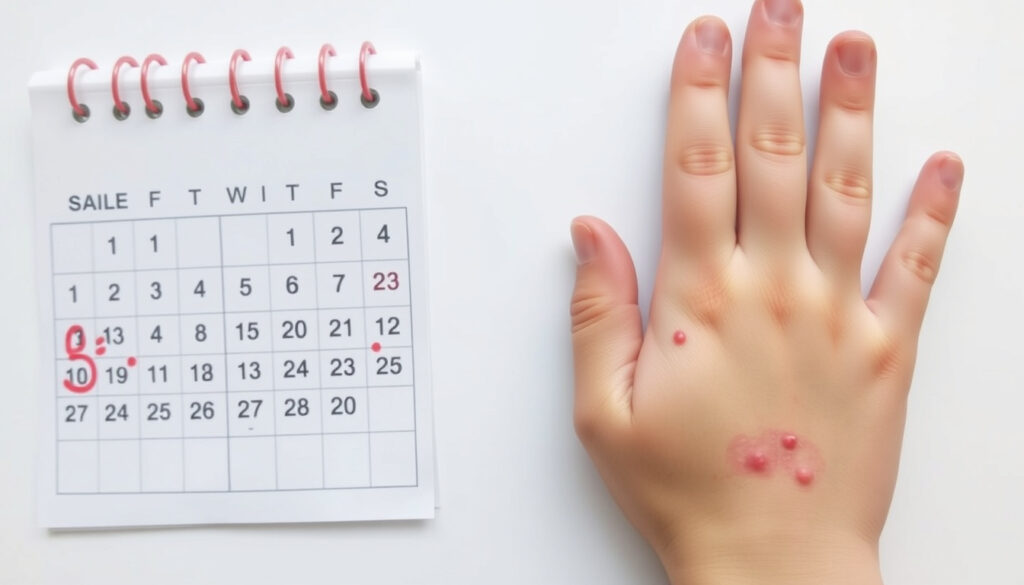
Early Signs Hand Foot and Mouth: Day-by-Day Guide
If your child suddenly develops a fever and a sore throat, hand, foot, and mouth disease (HFMD) might not be the first thing on your mind, but these subtle early signs are exactly how this common viral illness typically announces itself. This day-by-day guide walks you through what to expect from incubation through recovery, so you can spot early signs and know when to call the doctor.
Incubation period: 3–6 days ·
Most common age group: Children under 5 years ·
Average duration of illness: 7–10 days ·
Common first symptom: Fever (often >38°C) and sore throat
Quick snapshot
- HFMD is caused by enteroviruses, most commonly Coxsackievirus A16 (CDC)
- Incubation period is 3 to 6 days (Healthdirect)
- Why some children develop severe mouth ulcers while others have only a rash (Cleveland Clinic)
- Exact risk of transmission to adults living with an infected child (Cleveland Clinic)
- Whether the rash appears in all cases — estimates range from 75% to higher (Cleveland Clinic)
- Day 1–2: Fever and sore throat appear (CDC)
- Day 3–4: Rash and blisters peak on hands, feet, and mouth (Mayo Clinic)
- Day 5–7: Fever resolves, blisters crust (NHS)
A quick look at the core facts every parent should know about hand, foot, and mouth disease.
| Fact | What the data says |
|---|---|
| Incubation | 3–6 days |
| Common first symptom | Fever and sore throat |
| Rash onset | Day 2–3 |
| Duration | 7–10 days |
| Contagious period | From symptom onset until blisters heal |
| Treatment | Supportive care: hydration, pain relief |
What symptoms come first in hand, foot, and mouth?
First signs: fever, sore throat, loss of appetite
- According to the NHS (UK national health service), the first stage often includes a sore throat, high temperature, and not wanting to eat.
- The CDC (U.S. public health agency) lists fever, sore throat, and painful mouth sores that blister as key early symptoms.
- Cleveland Clinic (a leading U.S. medical center) describes a “vague viral illness” lasting a couple days: low fever, tiredness, sore mouth and throat, runny nose, stomachache, and loss of appetite.
The implication: these early symptoms can easily be mistaken for a common cold or flu, which often delays parents from linking them to HFMD.
Incubation period and early progression
- MedlinePlus (U.S. National Library of Medicine) states the time between contact with the virus and symptom onset is about 3 to 7 days.
- Both the CDC and Healthdirect (Australian government health service) agree on a 3–6 day incubation window.
- During this silent phase, the virus is already multiplying in the throat and gut, even though the child feels fine.
What this means: parents often don’t realize the child has been exposed until the first fever spikes — usually on Day 1 or 2 after incubation ends.
What does day 3 of HFM look like?
Rash and blister peak timeline
- By day 3, the rash and blisters are usually visible on the hands, feet, and mouth, according to the Mayo Clinic (a U.S. nonprofit academic medical center).
- NHS Inform (Scotland’s health information service) notes that soon after mouth ulcers appear, a rash of small raised red spots may be noticed on the skin.
- Blisters may also appear on the buttocks, knees, elbows, and genitals (Cleveland Clinic).
The pattern: Day 3 is often the worst for visible symptoms — the fever may persist, and the mouth sores can make eating and drinking painful.
Parents who know Day 3 will be the peak of blistering can better prepare with soft foods, cold drinks, and comfort measures — avoiding a frantic late-night call to the pediatrician.
The implication: recognizing the Day 3 peak helps caregivers plan ahead rather than react in distress when symptoms worsen.
What helps HFMD go away faster?
Over-the-counter pain relief
- Ibuprofen or acetaminophen can reduce fever and pain, as recommended by the Mayo Clinic.
- Always follow dosing guidelines for the child’s age and weight.
Hydration and soft food recommendations
- Cold fluids (milk, water, ice pops) and soft foods (yogurt, applesauce, smoothies) help soothe mouth sores.
- Avoid spicy, acidic, or salty foods that can sting.
When to see a doctor
- Seek medical care if the child cannot drink fluids, has a fever above 39°C for more than 3 days, or shows signs of dehydration (dry mouth, no tears, fewer wet diapers).
The catch: there is no antiviral or vaccine for HFMD — treatment is purely supportive. But early hydration management can prevent hospital visits.
- Start pain and fever management — Give ibuprofen or acetaminophen according to weight-based dosing to keep the child comfortable.
- Prioritize hydration — Offer small, frequent sips of water, milk, or ice pops to prevent dehydration when mouth sores make swallowing painful.
- Adjust the diet — Serve soft, cool foods like yogurt, applesauce, and smoothies; avoid anything spicy, acidic, or crunchy.
- Monitor for worsening signs — Track wet diapers or bathroom trips, and watch for fever above 39°C lasting more than 3 days.
- Limit spread — Keep the child home until fever resolves and blisters dry; wash hands thoroughly after diaper changes or contact with saliva.
Dehydration is the most common complication in young children with HFMD because mouth sores make swallowing painful. Track wet diapers or bathroom trips closely.
The pattern: a stepwise care plan reduces the chance of complications and shortens the stressful phase for both parent and child.
How likely are parents to get hand, foot, and mouth from their child?
Transmission risk to adults
- Adults can contract HFMD but often have milder symptoms, according to Duke Health (a U.S. academic medical center).
- The virus spreads via saliva, blister fluid, and stool — so changing diapers or sharing utensils increases risk.
Symptoms in adults vs children
- Adults may experience fever, sore throat, and a rash, but the blistering is often less severe.
- Some adults have no symptoms at all while still shedding the virus (CDC).
The trade-off: parents are at moderate risk, but most cases in adults are mild. Still, pregnant women and immunocompromised adults should take extra precautions.
Do parents need to quarantine if child has hand, foot, and mouth?
Isolation guidelines from CDC
- The CDC recommends keeping the child home while fever is present and blisters are open — typically about 5–7 days.
- Parents do not need to quarantine unless they develop symptoms themselves, per Healthline.
When is the child no longer contagious?
- The contagious period begins at symptom onset and lasts until all blisters have dried and crusted over (usually 7–10 days).
- Even after recovery, the virus can be shed in stool for weeks, so good hand hygiene remains important (CDC).
The pattern: quarantine applies to the sick child, not to the entire household. But parents should be vigilant for symptoms in themselves and other children.
Timeline signal
- Exposure (Day 0): Virus enters the body; no symptoms.
- Day 1–2: Fever, sore throat, loss of appetite, fatigue appear.
- Day 3–4: Rash and blisters peak on hands, feet, mouth, buttocks.
- Day 5–7: Fever resolves; blisters crust; appetite improves.
- Day 8–10: Most blisters healed; contagious period ends.
Confirmed facts vs what’s still uncertain
Confirmed facts
- HFMD is caused by enteroviruses, most commonly Coxsackievirus A16 (CDC)
- Incubation period is 3–6 days (CDC, NHS)
- Recovery typically takes 7–10 days (NHS)
What’s still uncertain
- Why some children develop severe mouth ulcers while others have only mild rash
- Whether adults require isolation if asymptomatic but exposed
- How long viral shedding in stool can last after recovery
- How common the rash truly is — estimates range from around 75% to higher (Cleveland Clinic)
“HFMD is usually not a serious illness. Most children recover in a week without complications.”
CDC (U.S. public health agency)
“The skin rash happens in 3 out of 4 cases, and it often forms on the hands and feet, especially the palms and soles.”
Cleveland Clinic (U.S. academic medical center)
“After 1 or 2 days, red spots may appear on the tongue and inside the mouth and quickly become larger yellow-grey ulcers with red edges.”
For parents navigating the first case of HFMD in the family, the decision is clear: support the child with hydration and pain relief, monitor for dehydration, and keep them home until the blisters dry. Prevention through hand washing and surface cleaning remains the best defense — and a parent who follows this timeline will face far less uncertainty when the next fever arrives.
ubiehealth.com, vinmec.com, intownpediatrics.com, droracle.ai, afcurgentcare.com
Frequently asked questions
What are the first signs of hand, foot, and mouth?
The first signs are typically fever (often above 38°C), sore throat, and loss of appetite. These can appear 3–6 days after exposure.
Can adults get HFMD from their child?
Yes, adults can contract HFMD, but symptoms are usually milder. Transmission occurs through saliva, blister fluid, and stool.
How long does HFMD last?
The illness typically lasts 7–10 days from the first fever to complete healing of blisters.
When does the rash appear?
The rash and blisters usually appear on day 2–3 after the fever starts.
Is hand, foot, and mouth dangerous?
HFMD is usually mild and self-limiting. Rare complications include viral meningitis, but these are uncommon.
What food should I avoid with HFMD?
Avoid spicy, acidic, salty, or crunchy foods that can irritate mouth sores. Stick to soft, cool foods.
Can I hug my child with HFMD?
Yes, hugging is low-risk if there are no open blisters on the child’s hands or mouth. Wash hands afterward.
Do parents need to quarantine?
Parents do not need to quarantine unless they develop symptoms. The child should stay home until fever is gone and blisters are dry.
Meer gerelateerde berichten
 Family Law Attorney Near Me: Costs & Free Advice in Ireland
 Tour de France Standings 2025: Final GC Leaderboard
 2024 Max 401k Contribution: Limits, Catch-Up, and HCE Rules
 Chick-fil-A Salads: Menu, Health Rankings & Nutrition
 Oklahoma City Thunder vs Indiana Pacers Stats: 2025 Finals
 Stimulus Check Eligibility Payments 2025 – Requirements, Amounts and Status
 When Does Walmart Close? Store Hours & Holiday Schedule
 Michael B. Jordan Filmography: Movies, TV & Roles List