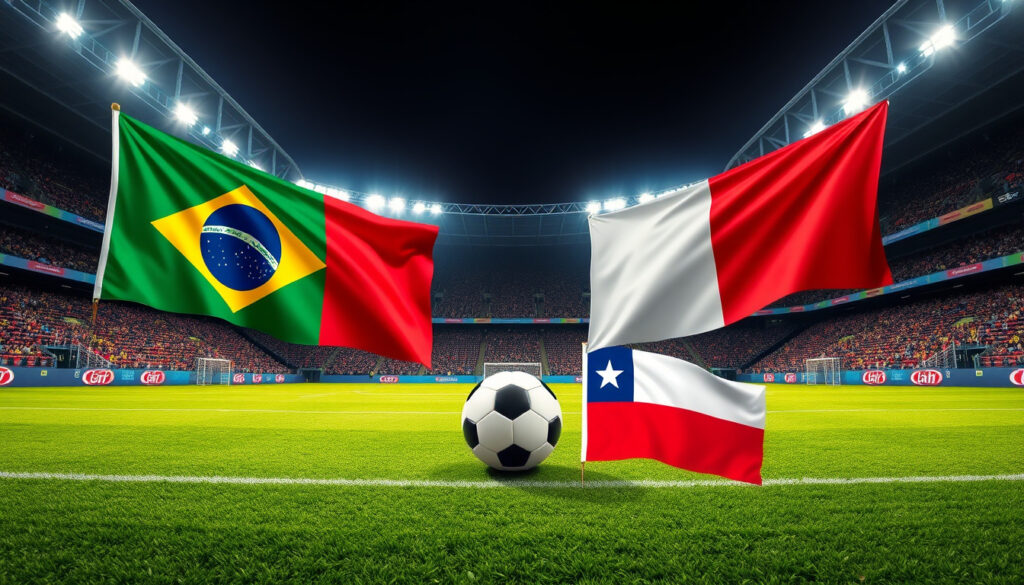
Brazil National Football Team vs Chile National Football Team Lineups – Confirmed and Predicted XIs
The confirmed starting lineups for Brazil versus Chile in the September 3, 2025 CONMEBOL World Cup Qualifier have been released, with both sides fielding significantly changed squads from previous campaigns. The match took place at Maracanã Stadium in Rio de Janeiro, marking a pivotal moment in the CONMEBOL qualification race.
Brazil, already secured for the 2026 World Cup following their June victory over Paraguay, approached the fixture with an experimental mindset under newly appointed coach Carlo Ancelotti. Chile, meanwhile, found itself at the bottom of the standings with everything to play for in their bid to escape relegation from the qualification table.
The confirmed XIs revealed tactical approaches that diverged from pre-match predictions, with younger players given opportunities on both sides. This article provides a comprehensive breakdown of the lineups, team news, historical context, and the key factors that shaped selection decisions for this encounter.
Confirmed and Predicted Lineups for Brazil vs Chile
Brazil’s confirmed starting eleven featured Alisson between the posts, with a defensive line of Douglas Santos, Gabriel Magalhães, Marquinhos, and Wesley providing protection in front of him. Casemiro and Bruno Guimarães anchored the midfield in a double pivot role, allowing the attacking midfielders greater freedom to press and create.
The forward line showcased Brazil’s evolving attacking options, with Gabriel Martinelli and Raphinha operating as wide threats while Estevão, the young Chelsea signing, occupied the number ten position. João Pedro led the line as the sole striker in a 4-2-3-1 formation that prioritized defensive solidity while maintaining counter-attacking potency.
Chile’s confirmed XI differed from several pre-match predictions, with Lawrence Vigouroux occupying the goalkeeper position. The defensive unit comprised Paulo Diaz, Guillermo Maripan, and Ivan Roman, with Fabián Hormazábal completing the backline. The midfield three consisted of Vicente Pizarro, Felipe Loyola, and Gabriel Suazo, providing a blend of energy and technical ability through the centre of the park.
Brazil set up in a 4-2-3-1 formation while Chile adopted a 4-3-3 structure, creating an intriguing tactical contrast. Brazil’s double pivot of Casemiro and Bruno Guimarães offered additional protection against Chile’s three-man midfield, potentially allowing the attacking quartet to press higher up the pitch.
Several outlets had published predicted lineups in the days leading up to the match, with Sports Illustrated providing detailed previews that closely matched the confirmed selections. FotMob offered live statistical coverage throughout the matchday, tracking formations and individual player performances in real time.
Key Players and Tactical Roles
Raphinha assumed a central attacking role despite the presence of established forwards in the squad, taking on creative responsibilities alongside the younger Estevão. The partnership between Gabriel Martinelli and Estevão, both Chelsea players, provided an interesting dynamic in the final third, with the duo combining pace and technical skill to unlock opposition defenses.
For Chile, Alexander Aravena represented a key attacking outlet, with Ben Brereton Diaz and Lucas Cepeda supporting the strike force. The absence of veteran experience in the midfield meant younger players bore greater responsibility in controlling the tempo and transitioning between defense and attack.
| Team | Goalkeeper | Defenders | Midfielders | Forwards |
|---|---|---|---|---|
| Brazil | Alisson | Douglas Santos, Gabriel Magalhães, Marquinhos, Wesley | Casemiro, Bruno Guimarães | Martinelli, Raphinha, Estevão; João Pedro (ST) |
| Chile | Lawrence Vigouroux | Paulo Diaz, Guillermo Maripan, Ivan Roman, Fabián Hormazábal | Pizarro, Loyola, Suazo | Cepeda, Brereton Diaz, Aravena |
Pre-Match Prediction Accuracy
The Brazil World Cup Blog match thread documented the evolution of lineup predictions throughout the build-up, revealing how closely most sources anticipated the confirmed selections. The defensive selections proved particularly accurate, with Douglas Santos and Wesley correctly identified as the full-back pairing weeks before the match.
An August 2025 YouTube prediction video had suggested an alternative 4-3-3 formation featuring Militão, Alex Sandro, Éderson, Philippe Coutinho, and Lucas Paquetá. This lineup ultimately proved incorrect, highlighting how quickly squad dynamics shifted following Ancelotti’s appointment and subsequent tactical experiments.
The Brazil National Team Under Carlo Ancelotti
Carlo Ancelotti’s appointment as Brazil head coach in June 2025 marked a significant shift in the Seleçao’s approach to World Cup qualification. The Italian tactician, widely regarded as one of the most successful club managers in football history, brought a philosophy centred on tactical flexibility and squad rotation that diverged from his predecessors’ methods.
Since taking charge, Ancelotti has guided Brazil to an unbeaten record in qualification matches, with the 1-0 victory over Paraguay in June 2025 securing their place at the 2026 World Cup. This early qualification allowed Ancelotti to approach subsequent matches with reduced pressure, creating opportunities to evaluate players and test different tactical systems.
Ancelotti’s decision to exclude established stars like Neymar, Vinícius Júnior, and Rodrygo reflected a deliberate policy of opportunity over continuity. The coach stated publicly that he wanted to assess alternatives to his first-choice lineup, prompting public response from Neymar, who contradicted Ancelotti’s explanation for the omission.
Key Absences and Selection Decisions
The exclusion of Neymar generated significant attention in the football world. At 33 years old, Brazil’s all-time leading scorer found himself omitted from the matchday squad alongside Vinícius Júnior and Rodrygo. Ancelotti’s stated rationale centred on evaluating other options, though Neymar publicly disputed this characterization.
Injuries further complicated squad selection, ruling out Matheus Cunha and Alex Sandro before the final lineup was confirmed. These absences created opportunities for players like João Pedro and Estevão to feature from the start, with both taking full advantage of their selections.
The tactical setup under Ancelotti emphasized balance between defensive structure and attacking creativity. The 4-2-3-1 formation provided defensive solidity through Casemiro and Bruno Guimarães while allowing the attacking quartet significant freedom to express themselves in the final third.
Chile’s Qualification Battle and Squad Evolution
Chile entered the matchday occupying the bottom position in the CONMEBOL qualification table, having accumulated just 10 points from 16 matches. The team sought its first victory in five games, with the pressure of potential qualification failure adding urgency to every remaining fixture.
Coach Nicolás Córdova responded to his team’s struggles by blooding younger players and omitting several established veterans. Alexis Sánchez, Arturo Vidal, and Charles Aránguiz, all pivotal figures in Chile’s golden era that produced back-to-back Copa América titles, were left out of the squad entirely, signaling a clear intent to rebuild for future campaigns.
With Chile sitting at the bottom of the qualification table, this match carried far greater significance for the visitors than for Brazil. A positive result could provide momentum for the remaining qualification matches while a defeat would intensify pressure on the coaching staff and federation hierarchy.
The tactical approach adopted by Córdova featured a 4-3-3 formation designed to maximize width and provide running power through the flanks. This system aimed to exploit potential spaces behind Brazil’s advanced full-backs while offering defensive security through numerical superiority in the middle third.
Historical Dominance in Recent Encounters
Brazil’s recent record against Chile proved overwhelmingly dominant, with five consecutive victories in qualification matches. The most recent encounter before September 2025 resulted in a 2-1 victory for Brazil on October 10, 2024, exemplifying the competitive imbalance that has characterized the fixture in recent years.
Chile’s failure to secure any wins or draws against Brazil during this period underscored the scale of the challenge facing Córdova’s side. Despite possessing talented individual players, the collective gap between the two nations had widened considerably since Chile’s competitive peak.
The psychological dimension of facing a dominant rival while fighting for qualification survival created a complex dynamic for the Chilean squad. Players were tasked with overcoming years of negative results while simultaneously navigating the pressure of must-win football at the highest level of international competition.
The 2014 World Cup Connection
The 2014 World Cup hosted by Brazil provided historical context for encounters between the South American rivals, though specific lineup details from that tournament differ significantly from recent qualification matches. Brazil’s qualification campaign for their home World Cup contributed to their tournament preparation, establishing patterns of squad rotation and tactical experimentation that would define subsequent cycles.
In the Round of 16 at the 2014 World Cup, Brazil faced Chile in a memorable encounter that ended 1-1 after extra time. The subsequent penalty shootout saw Brazil advance 3-2, with the match widely regarded as one of the tournament’s most emotionally charged fixtures. The tactical approach and player selections from that match reflect a different era in both nations’ football development.
While Brazil ultimately went on to host the 2014 World Cup following their qualification campaign, the competitive nature of CONMEBOL qualification remains as challenging as ever. The current 2026 qualification cycle reflects evolved tactical approaches and generational shifts in both national team programs.
For qualification purposes, the current encounter represented a different competitive reality, with Brazil focused on maintaining momentum and Chile fighting for survival. The lineup selections from each era demonstrate how both programs have evolved their approaches to major tournament qualification.
Match Timeline and Build-Up
The journey to the September 3, 2025 matchday at Maracanã Stadium followed a complex path shaped by managerial changes, tactical experiments, and qualification mathematics. Understanding the sequence of events provides essential context for the lineup decisions implemented on matchday.
- June 2025 – Carlo Ancelotti officially appointed as Brazil head coach, beginning preparation for the second half of the qualification campaign.
- June 2025 – Brazil secures 2026 World Cup qualification following a 1-0 victory over Paraguay, the decisive result that allowed experimental selection policies.
- August 2025 – Early predicted lineups circulated across sports media, suggesting alternative formations and personnel changes.
- Early September 2025 – Ancelotti announces squad exclusions, including Neymar, Vinícius Júnior, and Rodrygo, generating public controversy.
- September 3, 2025 – Matchday 17 at Maracanã Stadium, with confirmed lineups released hours before kickoff.
The timeline reveals how Brazil’s early qualification transformed their approach to remaining matches, while Chile’s struggles intensified with each passing international window. The Maracanã venue added historical significance to an otherwise low-stakes encounter from Brazil’s perspective but a crucial one for Chilean qualification hopes.
What Was Confirmed and What Remains Unclear
The confirmed lineups were released through official channels, establishing the following with certainty: Brazil’s 4-2-3-1 formation, the inclusion of Alisson, Marquinhos, Gabriel Magalhães, and Bruno Guimarães, Chile’s 4-3-3 setup, and the omission of established veterans from both squads. The match date, venue, and qualification context were definitively established through multiple sources.
Several aspects of the encounter remain subject to interpretation: the precise substitution patterns and timing, the specific tactical adjustments implemented during the match, post-match reactions from omitted players, and the implications for future squad selection. The long-term impact of Ancelotti’s experimental approach on Brazil’s World Cup prospects requires observation across subsequent fixtures.
The relationship between confirmed pre-match information and actual matchday developments highlighted the dynamic nature of international football selection. While lineup announcements provided definitive information hours before kickoff, the fluid nature of player fitness and tactical preferences meant that some details could only be confirmed upon match completion.
The Broader CONMEBOL Qualification Context
The CONMEBOL qualification process for the 2026 World Cup represents one of football’s most demanding competitive landscapes, with ten national teams competing for limited qualification spots. The format rewards consistency across an extended campaign while punishing sustained periods of poor form, creating unique pressures for teams at various stages of their development cycles.
Brazil’s position as a qualification certainty provided Ancelotti with unprecedented flexibility in squad selection, allowing the evaluation of players who might not otherwise feature in high-pressure qualification matches. This approach, while potentially risky in terms of results, offered valuable information about depth options for the World Cup proper.
Chile’s predicament illustrated the harsh realities of the qualification process, where past success provides no immunity from future struggles. The decision to rebuild with younger players reflected a pragmatic acceptance that immediate results might suffer in exchange for longer-term competitive development.
The Brazilian Football Confederation supported Ancelotti’s experimental approach, recognizing the value of thorough preparation for a home World Cup in 2026. This institutional backing allowed the coaching staff to prioritize evaluation over results in matches where qualification mathematics permitted such flexibility.
Key Sources and Perspectives
Multiple outlets provided coverage of the match lineups and team news, with each source offering distinct perspectives on the selection decisions. BolaVIP delivered comprehensive team news coverage, while World Soccer Talk provided detailed tactical analysis of the predicted formations.
“Brazil’s decision to exclude Neymar, Vinícius Júnior, and Rodrygo reflects a strategic prioritization of squad evaluation over immediate results, with Ancelotti publicly stating his desire to assess alternative options.”
The Sports Illustrated preview offered extensive analysis of the tactical matchup, examining how both teams planned to approach the fixture. Their coverage highlighted the generational transition occurring within both national team programs, with experienced players making way for emerging talents.
Statistical platforms like FotMob provided real-time updates throughout matchday, tracking individual performances and formation changes. The Brazil World Cup Blog offered match thread coverage that captured the social media reaction and instant analysis following lineup announcements.
Summary and Looking Ahead
The September 2025 World Cup qualifier between Brazil and Chile delivered significant lineup surprises, with Ancelotti’s experimental approach producing a transformed Seleçao side. The confirmed XI featured younger players in key positions, reflecting Brazil’s newfound flexibility following qualification security.
Chile’s youth-focused selection represented a necessary but challenging transition, with the South American nation prioritizing long-term development over immediate qualification survival. The result of this match would influence the trajectory of both programs as they continued their separate journeys toward the 2026 World Cup.
For comprehensive coverage of CONMEBOL qualification matches and national team news, explore our dedicated resources on CONMEBOL World Cup Qualifiers and the Brazil National Team Squad.
Frequently Asked Questions
Who starts for Brazil against Chile in the World Cup qualifier?
Brazil’s confirmed starting XI featured Alisson; Douglas Santos, Gabriel Magalhães, Marquinhos, Wesley; Casemiro, Bruno Guimarães; Gabriel Martinelli, Raphinha, Estevão; João Pedro in a 4-2-3-1 formation at Maracanã Stadium.
What formation did Chile use against Brazil?
Chile adopted a 4-3-3 formation with Lawrence Vigouroux; Paulo Diaz, Guillermo Maripan, Ivan Roman, Fabián Hormazábal; Vicente Pizarro, Felipe Loyola, Gabriel Suazo; Lucas Cepeda, Ben Brereton Diaz, Alexander Aravena.
Why was Neymar excluded from Brazil’s squad?
Coach Carlo Ancelotti excluded Neymar, Vinícius Júnior, and Rodrygo to evaluate other players in the squad. Ancelotti stated the decision was part of assessing alternatives, though Neymar publicly responded and contradicted this explanation.
How did Brazil qualify for the 2026 World Cup?
Brazil secured 2026 World Cup qualification following a 1-0 victory over Paraguay in June 2025. This result provided the Seleçao with mathematical qualification with several matches remaining in the campaign.
Who is Chile’s coach for the World Cup qualifiers?
Nicolás Córdova managed Chile during the 2026 World Cup qualification campaign. He implemented a youth-focused approach, omitting veterans Alexis Sánchez, Arturo Vidal, and Charles Aránguiz in favor of developing younger players.
Where was the Brazil vs Chile match played?
The match took place at Maracanã Stadium in Rio de Janeiro on September 3, 2025, for Matchday 17 of the CONMEBOL World Cup qualification process.
What was Brazil’s recent record against Chile?
Brazil won five consecutive qualification matches against Chile before September 2025, including a 2-1 victory on October 10, 2024. Chile failed to secure any wins or draws during this period.
What happened in the 2014 World Cup between Brazil and Chile?
At the 2014 World Cup hosted by Brazil, the two nations met in the Round of 16. The match ended 1-1 after extra time, with Brazil winning the subsequent penalty shootout 3-2 to advance to the quarter-finals.
Meer gerelateerde berichten
 Black Eyed Peas Food: Health, Names, Recipes & Global Traditions
 Chick-fil-A Salads: Menu, Health Rankings & Nutrition
 Best Translator Spanish to English: Accurate & Free Options
 Zack de la Rocha: Biography, Net Worth, Why He Left Rage
 How Old is the Earth? 4.54 Billion Years Explained
 Google Translate English to Chinese: Free Accurate Tool
 What Is Beef Tallow? Benefits, Uses, and Health Debate
 Best Tennis Shoes for Women in 2026: Reviews & Guide