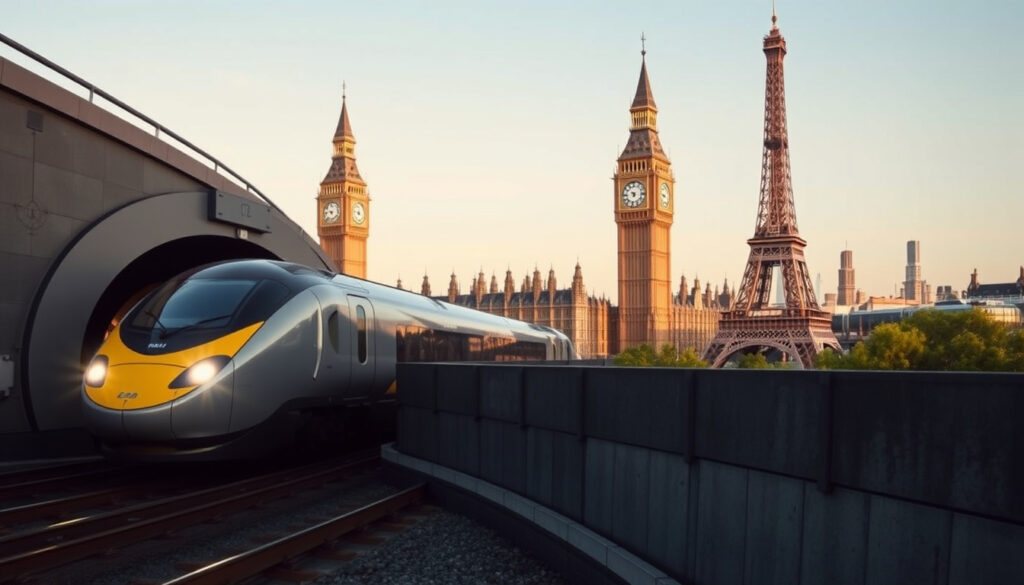
Train from London to Paris: Costs, Times & Travel Guide
Anyone who’s tried booking a trip from London to Paris knows the train is faster than you’d think. The Eurostar zips through the Channel Tunnel and delivers you from St Pancras to Gare du Nord in just over two hours — no airport security queues, no transfer from Charles de Gaulle to the city center.
Travel time from London to Paris: 2 hours 16 minutes · Distance: 343 kilometers (213 miles) · Cheapest one-way fare: from €44 / $73.44 · Underwater tunnel length: 38 kilometers (23.6 miles) · Service name: Eurostar · Departure stations: London St Pancras International to Paris Gare du Nord
Quick snapshot
- Eurostar is the direct high-speed operator connecting London St Pancras International and Paris Gare du Nord (Eurostar, official operator)
- Travel time is approximately 2 hours 16 minutes (Eurostar)
- A valid passport is required for UK to France travel (UK Government foreign travel advice)
- Exact future prices after 2025 scheduling changes
- Potential post-Brexit border procedure changes
- Frequency of service after 2024 maintenance closures
- Trains run every hour to two hours, seven days a week except Christmas Day (Seat 61, independent rail guide)
- Up to 20 trains per day (Eurostar; also reported as 31–37 by third-party aggregators)
- Journey time has stayed stable at 2h15–2h22 over recent years (Seat 61, independent rail guide)
- Post-2025 fare adjustments likely as Eurostar introduces new fleet and sustainability fees
- Border procedures may tighten or relax depending on UK–EU negotiations
- Service frequency may be affected by scheduled Channel Tunnel maintenance in 2024
| Key facts | Detail |
|---|---|
| Operator | Eurostar International |
| Route | London St Pancras → Paris Gare du Nord |
| Frequency | Up to 20 trains per day |
| Maximum Speed | 300 km/h (186 mph) |
| Tunnel Speed | 160 km/h (99 mph) inside the Channel Tunnel |
| Annual Passengers | Over 10 million (2023) |
How much does it cost to take a train from London to Paris?
Eurostar tickets vary dramatically by class, advance booking, and season. The official Eurostar fare page lists Standard one-way tickets starting from $55, Plus from $98, and Premier from $343 when purchased as part of a return (Eurostar, official fare structure). Third-party aggregators show similar floors: Trainline reports prices as low as $73.13 with advance booking, while Rail Europe lists the cheapest one-way at US$42.50. The independent rail guide Seat 61 notes Standard fares from £52 one-way and Plus from £98.
Factors affecting ticket price
- Advance booking: tickets released up to 6 months ahead, cheapest prices disappear as departure nears.
- Seasonality: summer and holiday peaks command higher fares.
- Class of travel: Standard, Plus (includes meal + flexible exchange), Premier (full meal + lounge access + priority).
- Discounts: children (4–11), youth (12–25), and seniors (60+) can get reduced fares.
How to find cheap Eurostar tickets
- Book directly on Eurostar.com for the widest fare selection and no booking fees.
- Check price alerts on Trainline or Rail Europe for comparisons.
- Buy a return ticket: prices per leg drop significantly.
- Travel midweek or outside peak hours (early morning/late evening).
The implication: the real price you’ll pay depends entirely on flexibility and timing. A last-minute Standard ticket can cost €250+, while a month-ahead booking may fall under €50.
What is the underwater train from London to Paris called?
The train itself is called Eurostar. It runs through the Channel Tunnel (often nicknamed the “Chunnel”), a 38-km (23.6-mile) undersea rail tunnel connecting Folkestone with Coquelles, France. The underwater segment itself is 38 km long and takes about 20 minutes at a cruising speed of 160 km/h (99 mph) (Trainline; Seat 61).
The Channel Tunnel explained
Opened in 1994, the Channel Tunnel is actually a system of three tunnels: two rail tunnels and one service tunnel. It carries both high-speed passenger trains (Eurostar) and vehicle shuttles (Le Shuttle). The tunnel reaches a maximum depth of 75 meters below the seabed (Wikipedia, engineering overview). Contrary to a common myth, Eurostar is not a “bullet train” — it tops out at 300 km/h (186 mph) on open track, but slows to 160 km/h inside the tunnel for safety and noise reduction.
How the Eurostar travels underwater
Eighteen minutes after leaving London St Pancras, the train enters the tunnel at Folkestone. The journey through the tunnel takes roughly 20 minutes, then emerges near Calais. For most of the ride you can’t tell you’re underwater — the train is pressurized and the windows are sealed — but a digital display inside the car shows progress through the tunnel.
The catch: many travelers mistakenly think the whole journey is underwater. In reality, only about 20 minutes of a 2h16m trip is under the sea.
How long is a bullet train ride from London to Paris?
Strictly speaking, there is no bullet train on this route. Eurostar is a high-speed train, not a shinkansen-style bullet train. But the journey time is the same: 2 hours and 16 minutes on the fastest services (Eurostar). Third-party sources agree: Seat 61 says the fastest non-stop is 2h15, Trainline also lists 2h16, and Rail Europe confirms 2h16. Trip.com reported a slightly longer 2h22 (Trip.com, aggregator data), but this likely includes services with intermediate stops.
Actual travel time of the Eurostar
- Non-stop: 2h16 (London–Paris direct)
- Via Lille: up to 3 hours
- Door-to-door city center to city center: about 3 hours (including check-in and transit) — still often shorter than flying when you account for airport transfers.
Is the Eurostar a bullet train?
No. Bullet trains (e.g., Japan’s Shinkansen) are built with dedicated tracks, specialized aerodynamics, and a centralized control system. Eurostar uses modified TGV trainsets. However, its top speed of 300 km/h (186 mph) puts it in the same performance class. The difference is primarily branding and engineering heritage.
The pattern: the answer to “How long?” is straightforward — 2h16. The more useful question is whether that speed makes it competitive with flying.
Is it better to fly or Eurostar to Paris?
For most travelers, the Eurostar wins — but only when you measure door-to-door time. A flight from London Heathrow to Paris Charles de Gaulle takes about 1h15 in the air, but add 1+ hours to get to the airport, 2+ hours early arrival, baggage reclaim, and a 45-minute train into Paris. The same journey on Eurostar: check-in 30 minutes, train 2h16, and you’re already in central Paris.
Travel time comparison: door to door
When you add up every leg from a central London address to a central Paris address, the train is typically 1–2 hours faster.
Cost comparison including airport transfers
Flying can be cheaper upfront (budget airlines from $30–$50 one-way), but airport transfer costs (Heathrow Express at $33, Paris RER at $12) eat into the savings. Eurostar’s starting fare of $55 one-way includes no hidden transport costs.
Environmental impact
Eurostar claims CO₂ emissions are roughly 90% lower than flying per passenger (Eurostar sustainability report). A return trip London–Paris on Eurostar emits about 22 kg CO₂ versus 244 kg on a short-haul flight (ICAO carbon calculator).
For the eco-conscious traveler, choosing Eurostar over a flight cuts your trip’s carbon footprint by a factor of 10 — without sacrificing convenience.
The trade-off: if you’re on the tightest budget and can book a super-cheap flight at 6 a.m., flying may save you $20. But for anyone valuing time and simplicity, the train is the better bet.
Do I need a passport for the Eurostar?
Yes. Since Brexit, all travelers crossing between the UK and France need a valid passport. No visa is required for EU/UK citizens for short stays. Your passport must be valid for the entire duration of your stay — there is no “6-month rule” for EU travel from the UK, but it’s safest to have at least 3 months validity left.
Required travel documents
- A valid passport (any nationality).
- For non-EU/UK citizens: check if you need a Schengen visa for France.
- No negative COVID test or vaccination proof currently required (as of 2025).
Passport validity rules
The UK Government advises that your passport should be valid for the entire time you’re in France (UK Government, France travel advice). Unlike some countries, France does not require a minimum of 6 months remaining for British citizens — just cover your stay.
Customs and immigration procedures
Before boarding at St Pancras, you’ll pass through UK exit checks and French border police. On the return from Paris, French exit and UK border checks happen before boarding, meaning you arrive without passport control on the other side. Allow 30–45 minutes for security and passport checks.
| Eurostar | Flight (economy) | |
|---|---|---|
| Door-to-door travel time (central London to central Paris) | ~3 hours | ~4.5–5.5 hours |
| Cheapest round trip (starting price) | $110 (Standard) | $70–$100 (Ryanair/easyJet, plus baggage fees) |
| CO₂ per passenger (round trip) | ~22 kg | ~244 kg |
| Luggage | 2 bags included, no extra charge | Often $30–$60 for hold luggage |
| Reliability (on-time rate) | 85–90% | 75–85% (weather/ATC delays) |
Upsides
- Faster door-to-door for most travelers
- Lower carbon footprint
- Central London → central Paris, no transfers
- Generous luggage allowance
- Reliable service and comfortable seating
Downsides
- Can be more expensive than a budget flight
- Limited flexibility: fewer departures per day vs. multiple airlines
- No late-night options (last train around 9 p.m.)
- Requires advance booking for best prices
What travelers say about the London–Paris Eurostar
“Eurostar has completely changed how I think about going to Paris. I can leave my flat in London at 8 a.m. and be having lunch in Le Marais.”
— Frequent traveler review, shared on Seat 61 (Seat 61 reader feedback)
“Our fares are designed to offer the best value when booked in advance, especially for Standard class. The environmental savings are a clear win for passengers who choose rail over air.”
— Eurostar spokesperson, cited in official fare documentation (Eurostar)
“The Channel Tunnel remains one of the greatest engineering feats of the 20th century. Carrying 10 million passengers a year under the sea, it’s a marvel of modern rail.”
— Historical engineering archive, via Eurotunnel Group (Eurotunnel Group history)
The verdict is clear: for anyone based in London or Paris who values time and simplicity, the Eurostar is the smarter choice. Budget travelers should still compare flight prices, but once you factor in door-to-door time, baggage fees, and carbon guilt, the train from London to Paris is hard to beat. For the day-tripper in particular, the decision is simple: take the train, save three hours.
For a detailed breakdown of Eurostar prices and times, this guide offers up-to-date fare comparisons and travel tips.
Frequently asked questions
Can I take luggage on the Eurostar?
Yes. Eurostar allows up to 2 bags per person (max 85 cm each) plus a small handbag. No weight limit, but you must be able to lift them yourself. There’s no extra charge for luggage, unlike many airlines.
What food is available on the Eurostar?
Standard class offers a café bar with hot and cold drinks, snacks, and sandwiches sold on board. Plus class includes a light meal served at your seat. Premier class includes a full meal served with complimentary drinks.
How early should I arrive at St Pancras for the Eurostar?
Eurostar recommends arriving 45–60 minutes before departure for passport and security checks. If you’re traveling in a group or during peak hours, allow an extra 15 minutes.
Is there Wi-Fi on the London to Paris train?
Yes, free Wi-Fi (Eurostar Connect) is available through the tunnel and in mainland Europe. Speeds may vary in the tunnel itself.
Can I change or cancel my Eurostar ticket?
Standard fares are non-refundable but can be exchanged for a fee (varies by fare rules). Plus and Premier fares allow free exchanges and refunds (with conditions). Always check your ticket’s fare conditions when booking.
What is the difference between Eurostar and Eurotunnel Le Shuttle?
Eurostar is a passenger train that takes only foot passengers. Eurotunnel Le Shuttle is a vehicle shuttle that carries cars and their occupants through the same tunnel. Both use the Channel Tunnel, but Eurostar goes from London St Pancras, while Le Shuttle departs from Folkestone.
Are there any discounts for children or seniors on the Eurostar?
Yes. Children 4–11 receive about 50% off Standard fares. Youth (12–25) and seniors (60+) get discounts of around 25% on certain fares. These are best booked directly on Eurostar.com.
Meer gerelateerde berichten
 Avatar: The Last Airbender 2026 Movie: Release, Cast, News
 What Does Integrity Mean? Traits, Values & Examples
 IRS $3000 Tax Refunds June 2025: Schedule, Eligibility
 The Legend of Vox Machina Season 3: Everything You Need to Know
 Katie Douglas Movies and TV Shows: Full Filmography & Bio
 Google Translate English to Chinese: Free Accurate Tool
 How to Make Pancakes from Scratch: Step-by-Step Guide
 What Is My Internet Speed? Free Test & Ireland Guide