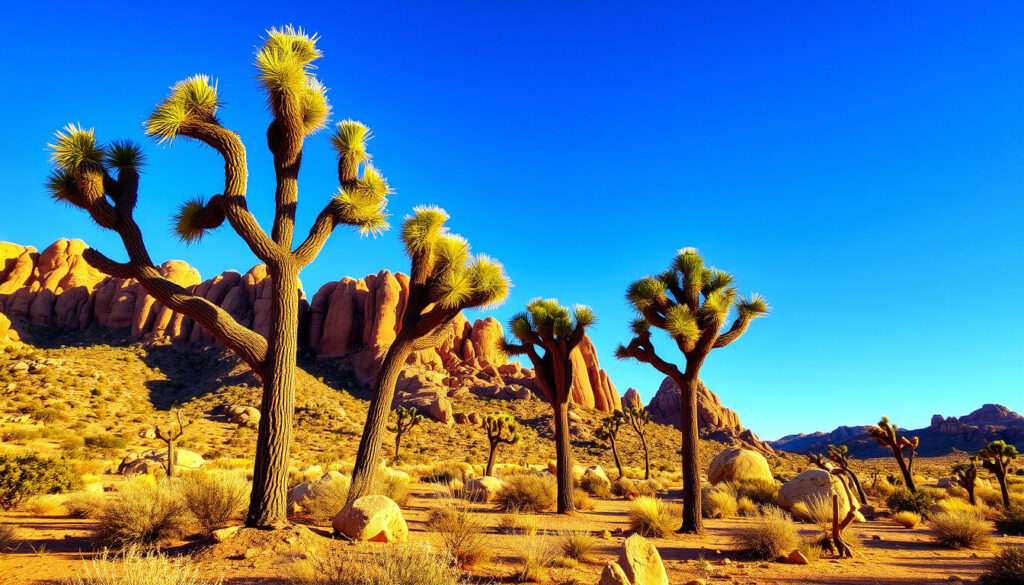
Joshua Tree National Park: Guide to Visiting, Best Time & Tips
There’s a reason millions of people make the drive to this stretch of California desert every year. Joshua Tree National Park isn’t just a collection of spiky yuccas — it’s a place where two distinct deserts collide, creating a landscape that feels both alien and familiar.
Established: 1994 ·
Area: 1,235.37 sq mi ·
Annual visitors: Over 3 million ·
Elevation range: 1,000–5,000 ft ·
Desert ecosystems: Mojave and Colorado ·
Dark Sky Park: Since 2017
Quick snapshot
- Joshua trees are yuccas, not trees (National Park Service (official site))
- Park open 24/7 all year (National Park Service – hours and policies) (National Park Service (official site))
- No water available in interior (National Park Service – visitor advisory) (National Park Service (official site))
- Over 8,000 climbing routes (National Park Service – climbing info) (National Park Service (official site))
- Exact mountain lion population (True Wind Healing Travel (desert travel blog))
- Long-term climate impact on Joshua trees (Six Moon Designs (outdoor gear guide))
- Future reservation system possible (Fieldtrip (travel planning blog))
- 1936 – National monument designation (National Park Service – park history)
- 1994 – Became a national park (National Park Service – establishment)
- 2017 – International Dark Sky Park (National Park Service – dark sky)
- 2020 – Record 4 million visitors (Fieldtrip (travel planning blog))
- Climate change could alter Joshua tree habitat (National Park Service – ecosystem research)
- Possible peak-season reservation system (Fieldtrip (travel planning blog))
- Ongoing trail expansions and improvements (National Park Service – projects)
Eight key facts, one takeaway: Joshua Tree is a dual-desert park that demands preparation and rewards planning.
| Attribute | Details |
|---|---|
| Established | 1994 (as national park) |
| Area | 1,235.37 sq mi |
| Annual visitors | 3+ million (2023) |
| Elevation | 1,000 – 5,000 ft |
| Desert types | Mojave (higher, cooler) and Colorado (lower, hotter) |
| Notable wildlife | Joshua tree, desert tortoise, mountain lion, bighorn sheep |
| Climbing routes | Over 8,000 |
| Dark Sky designation | Yes (since 2017) |
What is special about Joshua Tree National Park?
Unique landscapes and rock formations
- The park straddles two deserts: the higher Mojave and the lower Colorado (National Park Service (official park page)).
- Its iconic rock piles — like Skull Rock and Arch Rock — draw climbers and photographers from around the world (True Wind Healing Travel (desert travel guide)).
The dual-desert boundary means you can hike through juniper-pinyon woodland in the morning and feel true low-desert heat by afternoon — a rare ecological handshake that most parks can’t offer.
Wildlife and plant life
- Joshua trees (Yucca brevifolia) are actually a species of yucca, not a true tree (National Park Service – plant identification).
- Mountain lions (Puma concolor) are native but rarely seen; estimates vary (True Wind Healing Travel (wildlife report)).
- Desert tortoises and bighorn sheep also inhabit the park (National Park Service – wildlife guide).
Cultural and historical significance
- Established as a national monument in 1936 by President Roosevelt and upgraded to a national park in 1994 (National Park Service – park history).
- Designated an International Dark Sky Park in 2017 (National Park Service – dark sky certification).
The implication: Joshua Tree isn’t just a pretty rock pile — it’s a protected slice of two desert worlds, a haven for astronomy, climbing, and solitude that 3 million people a year can’t be wrong about.
What is the best month to visit Joshua Tree?
Spring (March – May): peak wildflowers and mild temperatures
- Wildflower blooms typically peak in March and April (True Wind Healing Travel (seasonal guide)).
- Temperatures: comfortable 70–85°F (21–29°C) days with lows around 50°F (10°C) (NPS – first-time visitors).
- Spring break (mid-March to mid-April) is the busiest period (NPS – crowd calendar).
Fall (October – November): comfortable weather, fewer crowds
- Daytime highs similar to spring, but with thinner crowds outside holidays (Six Moon Designs (outdoor gear guide)).
- October to November is often cited as the sweet spot (Fieldtrip (travel planning blog)).
Winter (December – February): cold nights, clear skies
- Daytime highs 50–60°F (10–15°C), but subfreezing nights possible; snow can occur (NPS – weather).
- Dark-sky stargazing is best in winter due to earlier sunsets and clear air (National Park Service – night sky).
Avoid summer (June – August): extreme heat, high fire risk
- Daytime highs often exceed 100°F (38°C) (National Park Service – summer warning).
- Fire danger high, and many visitors struggle with heat-related illness (National Park Service – safety).
For a visitor from coastal California, the summer desert can be a shock — a single wrong timed hike can turn into a serious safety issue. The trade-off is clear: spring or fall for comfort, winter for stargazing, summer only if you’re equipped and out by 10 a.m.
The pattern: Joshua Tree’s visitor season mirrors the classic desert rhythm — mild shoulder months vs. punishing heat. Plan around that, not the other way.
How much time is needed to visit Joshua Tree National Park?
One-day visit: highlights and key stops
- A single day covers the main scenic drive with stops at Hidden Valley, Arch Rock, and Cholla Cactus Garden (True Wind Healing Travel (one-day itinerary)).
- Entry fee is valid for 7 consecutive days, so you can return without paying again (National Park Service – fees).
Two-day visit: deeper exploration and hiking
- Two days allow you to explore both desert ecosystems and tackle longer trails like Ryan Mountain (True Wind Healing Travel (two-day plan)).
- You can camp overnight (reservation required for 85% of sites) and experience the dark sky (NPS – camping rules).
Half-day visit: scenic drive and quick overview
- The park is open 24 hours, so an early morning or late afternoon drive through the main corridor works for time-crunched visitors (National Park Service – hours).
With no water inside the park and very limited cell service, a half-day visitor who runs out of water or gets a flat tire faces a real situation. Two days is the sweet spot: enough time to prepare, enjoy, and recover.
What this means: Most travelers who visit report that two days felt right — enough to see the iconic spots without rushing, with time left for a good hike and a campfire.
What major city is closest to Joshua Tree National Park?
- Palm Springs: ~45 miles (72 km) south – the nearest full-service city (Six Moon Designs (travel logistics)).
- The park has three entrances: West (Joshua Tree Village), North (Twentynine Palms), South (Cottonwood Spring) (National Park Service – directions).
- Driving time from Palm Springs to the West Entrance: about 1 hour (National Park Service – getting here).
The implication: If you fly into Palm Springs, you can be on a trail before noon. That makes Joshua Tree one of the most accessible national parks from a major transportation hub.
What airport do you fly into to get to Joshua Tree?
- Palm Springs International Airport (PSP) – closest commercial airport (~45 miles from West Entrance) (National Park Service – nearby airports).
- Other options: Ontario International (ONT) – ~85 miles; Los Angeles (LAX) – ~130 miles; Las Vegas (LAS) – ~215 miles (Six Moon Designs – airport distances).
- A rental car is essential – no public transit goes to the park (National Park Service – getting around).
The trade-off: Flying into PSP saves time but may cost more. Driving from LAX saves airfare but adds 2–3 hours each way. Choose based on your itinerary weight.
How to plan your Joshua Tree itinerary: step by step
These three steps take you from zero to a solid plan for any trip length.
- Decide your trip length. Half-day: drive the main road and stop at 2–3 overlooks. One day: add Hidden Valley and a short hike. Two days: include a longer trail (Ryan Mountain or 49 Palms Oasis) and a campsite (True Wind Healing Travel (itinerary ideas)).
- Book camping or lodging early. Nearly 85% of campsites require advance reservations, and they fill up six months ahead on holidays and spring weekends (NPS – campsite reservations).
- Pack for self-sufficiency. Bring at least 1 gallon of water per person per day, food, sunscreen, a paper map (no cell signal), and a first-aid kit (National Park Service – what to pack).
The park that feels most wild is also the one where you can’t rely on the visitor center for supplies. Your preparation is your safety net. The best itinerary is the one you actually pack for.
Why this matters: Most park emergencies come from underestimation — people who thought a half-day would be fine without water or a map. Follow this step-by-step, and you’ll be ahead of 90% of visitors.
Confirmed facts
- Joshua trees are not trees but a type of yucca (NPS – plant taxonomy)
- The park spans Riverside and San Bernardino counties (National Park Service – geography)
- Entrance fee is $30 per vehicle (2025) (National Park Service – fees)
What’s unclear
- Exact number of mountain lions in the park (estimates vary) (True Wind Healing Travel (wildlife))
- Long-term impact of climate change on Joshua tree population (Six Moon Designs (climate note))
- Whether reservations will be required in future peak seasons (Fieldtrip (travel planning blog))
Quotes and perspectives
“The best times to visit are fall and spring with comfortable temperatures and fewer crowds.”
— National Park Service (NPS – first-time visitor guide)
“We found that 2.5 days was enough to see the park, but an extra half-day would have been nice for the Ryan Mountain hike.”
— True Wind Healing Travel (desert travel blog)
“With no cell reception and no water, this is a park where you have to be entirely self-sufficient.”
— Six Moon Designs (outdoor gear guide for first-timers)
The pattern across perspectives: every source emphasizes preparation over spontaneity. This isn’t a park you can wing — and that’s precisely what makes it so rewarding.
Joshua Tree National Park delivers an experience that few other U.S. parks can match: a collision of two deserts, world-class climbing, and skies so dark you can see the Milky Way with the naked eye. But the catch is logistics. For the California traveler used to turning up and buying a bottle of water at the gift shop, the lack of services inside the park can be a rude awakening. For the prepared visitor, the payoff is enormous. The choice: bring everything you need and treat the desert with respect, or stay in Palm Springs and admire the view from a distance.
Visitors often find that a Joshua Tree National Park guide provides essential details on the best hiking trails and wildlife viewing spots.
Frequently asked questions
Can you drive through Joshua Tree National Park?
Yes. The park has a main paved road (Park Boulevard) that runs east-west connecting the West and North entrances. You can drive the entire route in about 1–1.5 hours without stopping (National Park Service – maps).
Is there an entrance fee?
Yes, $30 per vehicle (2025), valid for 7 consecutive days. Annual and America the Beautiful passes are also accepted (National Park Service – fees).
What should I pack for a day visit?
At least 1 gallon of water per person, food, sunscreen, hat, sturdy shoes, a paper map, a flashlight/headlamp, and a first-aid kit. Leave no trace and expect no cell service (National Park Service – packing list).
Are dogs allowed in Joshua Tree National Park?
Yes, dogs are allowed on a leash up to 6 feet in developed areas and campgrounds, but not on trails or in the backcountry (National Park Service – pets policy).
Can I climb the rock formations without a permit?
Day climbing does not require a permit. Overnight or big-wall climbs may need a wilderness permit. Check with visitor centers (National Park Service – climbing regulations).
Where can I stay inside the park?
Camping is the only option inside the park. There are nine campgrounds; nearly 85% of sites require reservations via Recreation.gov. No hotels or lodges (NPS – camping).
Is cell phone reception available in the park?
Very limited. Most of the interior has no signal. Download maps and information before you arrive (National Park Service – connectivity).
The questions most visitors ask all point to the same theme: preparation. The park rewards those who come ready.
Meer gerelateerde berichten
 What Is a Data Lake? Simple Definition vs Warehouse & Database
 Tiana’s Bayou Adventure Opening Dates: Magic Kingdom & Disneyland
 Michigan Minimum Wage 2025 – Rates, Tipped Wages, Increases
 PSG vs Aston Villa: Match Recap, How to Watch, and UCL History
 Massachusetts Institute of Technology: Rankings, MIT vs Harvard
 What Is Beef Tallow? Benefits, Uses, and Health Debate
 What Is My Internet Speed? Free Test & Ireland Guide
 Avatar Fire and Ash Showtimes – Tickets On Sale for Dec 19 Release