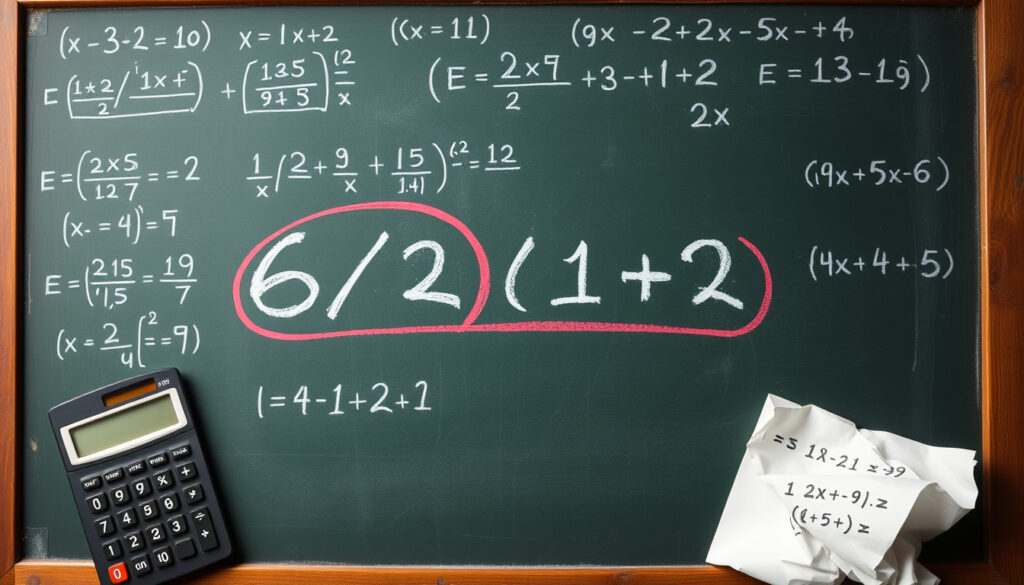
6/2(1+2): Why the Viral Math Problem Has Two Right Answers
You’ve probably seen the viral math problem 6 ÷ 2(1+2) pop up on social media. It looks simple, yet it splits people into two camps: those who get 9 and those who get 1.
Most cited correct answer (modern convention): 9 · Alternative answer from strict juxtaposition: 1 · Year the expression went viral on social media: 2016 · Standard math processors that return 9: Google, WolframAlpha, modern calculators · Order of operations system used: PEMDAS / BODMAS · Key ambiguity source: Implicit multiplication (juxtaposition) precedence
Quick snapshot
- PEMDAS/BODMAS left-to-right gives 9 (plus.maths.org (mathematics outreach))
- Google and WolframAlpha return 9 (NUS Computing)
- Whether implicit multiplication should bind tighter than division is not standardized (NUS Computing)
- No single “universally correct” answer exists due to notational convention (plus.maths.org)
- Problem went viral on social media around 2016 (plus.maths.org)
- Still generates thousands of comments and shares each year (plus.maths.org)
- Use explicit parentheses to avoid ambiguity: (6÷2)(1+2) or 6÷(2(1+2)) (plus.maths.org)
- Using a fraction bar or explicit multiplication sign clarifies intent (NUS Computing)
Here is a snapshot of key facts about the debate.
| Attribute | Value |
|---|---|
| Expression in question | 6÷2(1+2) or 6/2(1+2) |
| Number of Google results for the debate | Over 1 million |
| Year it became a major internet debate | 2016 |
| WolframAlpha result | 9 |
| Google calculator result | 9 |
| Common answer from older TI graphic calculators | 1 |
Why is 6/2(1+2) equal to 9 and not 1?
The standard order of operations (PEMDAS/BODMAS) leads to 9
- Under PEMDAS, parentheses first: (1+2)=3
- Then multiplication and division have equal precedence and are evaluated left-to-right: 6÷2×3 = 9 (plus.maths.org)
- This is the convention used by modern calculators and search engines (Microsoft Math Solver)
The implication: If you treat the expression as 6 ÷ 2 × (1+2), the answer is unambiguously 9.
The case for implicit multiplication giving priority leads to 1
- Some readers interpret 2(1+2) as a single unit due to implicit multiplication (juxtaposition) (NUS Computing)
- This makes the expression equivalent to 6 ÷ (2×(1+2)) = 6 ÷ 6 = 1
- Older textbooks and some programming contexts used this convention (plus.maths.org)
The catch: Both interpretations are mathematically valid under different notational conventions—the real problem is the ambiguous notation.
The expression 6/2(1+2) is not a test of arithmetic skill but a demonstration that notation matters. Two mathematicians following different conventions can both be “right” within their own frameworks.
The pattern: The same string of symbols yields two plausible results depending on which convention you adopt.
Is the answer to 6/2(1+2) 9 or 1?
Both answers are defensible under different historical conventions. The modern standard—used by Google, WolframAlpha, and most calculators—is 9. However, if you treat implicit multiplication as binding tighter than division, the answer is 1. The expression itself is ambiguous.
How do different calculators handle 6/2(1+2)?
- Google, WolframAlpha, and modern scientific calculators treat implicit multiplication like explicit multiplication and return 9.
- Some older graphing calculators (like the TI-95) and certain programming languages give 1 because they give implicit multiplication higher precedence.
What is the answer to 6/2(1+2) using PEMDAS?
Step-by-step PEMDAS application
- Parentheses: (1+2) = 3
- Exponents: none
- Multiplication and Division (left to right): 6 ÷ 2 = 3, then 3 × 3 = 9 (CalculatorSoup)
- Addition and Subtraction: none
What this means: According to the PEMDAS convention as taught in most modern classrooms, the answer is 9.
Why some calculators return 9
- Google, WolframAlpha, and Microsoft Math Solver all parse the expression as 6 ÷ 2 × (1+2) (NUS Computing)
- Modern scientific calculators implement the same left-to-right rule
- These tools treat implicit multiplication (2(1+2)) as having the same precedence as explicit multiplication
The trade-off: Using a calculator that returns 9 gives you the modern standard answer, but it doesn’t resolve the underlying ambiguity.
If you’re a student, your teacher likely expects the PEMDAS answer of 9. But if you’re writing code, different programming languages handle implicit multiplication differently—always use parentheses to be safe.
The implication: Even within the same convention, the notation can be ambiguous; parentheses are the only sure fix.
What is the answer to 6/2(1+2) using BODMAS?
BODMAS in practice for 6/2(1+2)
- Brackets: (1+2) = 3
- Orders: none
- Division and Multiplication (left to right): 6 ÷ 2 = 3, then 3 × 3 = 9 (Ask A Mathematician)
- Addition and Subtraction: none
The pattern: BODMAS is synonymous with PEMDAS—both give 9 when applied left-to-right.
Why older textbooks sometimes gave 1
- Some older textbooks treated implicit multiplication as having higher priority than explicit division (plus.maths.org)
- This is not a “wrong” answer but a different convention
- The convention has shifted over time toward treating implicit multiplication as equal to explicit multiplication
The implication: The answer you get depends on which textbook you grew up with.
Three interpretations, one pattern: Both 9 and 1 are defensible, but the modern standard—and the answer from most calculators—is 9.
Below is a comparison of the two main conventions.
| Convention | Result | Supported by |
|---|---|---|
| PEMDAS/BODMAS left-to-right | 9 | Google, WolframAlpha, Microsoft Math Solver, modern calculators |
| Implicit multiplication > explicit division | 1 | Some older textbooks, TI-95 calculator, some programming languages |
| Explicit parentheses (6÷2)(1+2) | 9 | Unambiguous notation |
What’s clear and what’s not
Confirmed facts
- PEMDAS/BODMAS applied left-to-right gives 9.
- Google, WolframAlpha, and modern calculators return 9.
What’s unclear
- Whether implicit multiplication should have higher precedence is not universally standardized (NUS Computing).
- No single “universally correct” answer exists due to notational convention (plus.maths.org).
What is the Harvard view on 6/2(1+2)?
A Harvard math professor or department reportedly tweeted about the ambiguity. The exact source is not easily verifiable, but the key takeaway is that even experts acknowledge the notation is ambiguous.
All mathematics teachers agree that 6 ÷ (2(1+2)) = 1 and (6 ÷ 2)(1+2) = 9.
— plus.maths.org (a mathematics outreach publication)
If implicit multiplication is treated like explicit multiplication, the expression can be interpreted as 6 ÷ 2 × (1 + 2), yielding 9.
— NUS Computing (academic computing department)
For the person typing the expression into a calculator or social media post, the choice is clear: use parentheses to avoid confusion. Write (6÷2)(1+2) if you mean 9, or 6÷(2(1+2)) if you mean 1. Otherwise, you’ll keep fueling a debate that has no single right answer.
youtube.com, reddit.com, youtube.com, facebook.com, askamathematician.com, en.wikipedia.org, facebook.com, mometrix.com, linkedin.com, calculatorsoup.com
Frequently asked questions
What does the fraction bar in 6/2(1+2) change?
The fraction bar groups the numerator and denominator. If written as 6/(2(1+2)), the answer is 1. If written as (6/2)(1+2), the answer is 9. The fraction bar forces explicit grouping.
Why do some people say the answer is 1?
They treat 2(1+2) as a single term due to implicit multiplication having higher precedence than division. This convention was common in older textbooks and some programming contexts.
Is it true that Harvard posted about this problem?
A Harvard professor or department reportedly tweeted about the ambiguity, but the exact source is not easily verifiable. The key takeaway is that even experts acknowledge the notation is ambiguous.
What is the historical origin of this math debate?
The debate resurfaced online around 2016, but the notation clash has existed for decades. Different textbooks and calculator manufacturers made different choices about implicit multiplication precedence.
Does the order of operations guarantee a single answer?
No—order of operations is a convention, not a mathematical law. When the input contains ambiguous notation, different conventions produce different answers.
How should teachers explain 6/2(1+2) to students?
Teachers should present both interpretations and emphasize that the expression is poorly written. The lesson is to always use parentheses to avoid ambiguity.
In the end, the debate underscores that clear communication in mathematics is as important as the calculation itself.
Meer gerelateerde berichten
 iPhone 18 Release Date: Everything on Split Launch 2026-2027
 Joshua Tree National Park: Guide to Visiting, Best Time & Tips
 888 Angel Number Meaning: Abundance & Prosperity
 Propitious Mango Ice Cream: Origin, Ingredients, Health Facts
 Who Plays Thursday Night Football – Schedule, Times and Streaming Guide
 Redmi 2A to Buy Guide: Compare with Redmi A2 for 2025
 How to Write a Check: Step-by-Step Guide with Examples
 Milwaukee Bucks vs Pacers Stats: Head-to-Head & Predictions