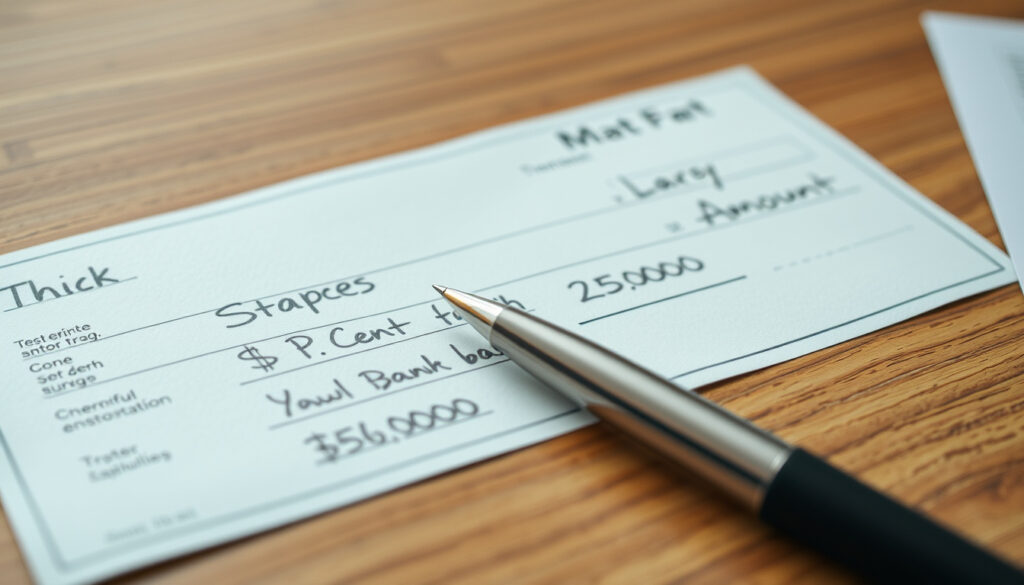
How to Write a Check: Steps with Cents and Large Amounts
Writing a check for the first time can feel intimidating, but the process follows a standardized six-step formula that major banks have used for decades. Once you learn the correct format for the numeric and written amounts, you’ll fill out every check with confidence.
Standard Steps: 6 · Date Position: Upper right corner · Amount Fields: Numeric and words · Signature Location: Bottom right line · Payee Line: Second line
Quick snapshot
- Six essential steps across all banks (Bankrate)
- Words amount wins if it conflicts with numbers (Consumer Finance Protection Bureau)
- Two decimal places always required (PNC Bank)
- Cents notation varies by country: US uses 00/100, Philippines uses period/comma (BPI (Philippine Banking Institution))
- Philippine date format switched to DD-MM-YYYY as of January 2, 2025 (BPI (Philippine Banking Institution))
- Signature must match bank records exactly (BB Americas)
- Line through unused space prevents fraud (AmeriChoice Federal Credit Union) (BB Americas)
- Blue or black ink only—never pencil (Bankrate)
- Store voided checks with your statement records
- Reconcile your checkbook after each transaction
- Order new checks when supply runs low
Five key fields define every personal check: where each goes on the paper and how to fill it without ambiguity. The table below shows the standard layout used by US banks.
| Field | Location / Format |
|---|---|
| Date Line | Top right-hand corner |
| Payee | Line after date |
| Numeric Amount | Box right side |
| Words Amount | Legal line below payee |
| Signature | Bottom right line |
How to write a check with cents
Writing the numeric amount looks straightforward until you hit the decimal. The box on the right side of the check accepts dollars and cents separated by a decimal point, and it requires exactly two digits after the decimal—whether you have cents or not. For $20, the box reads $20.00; for $105.50, it reads $105.50. Start your number as close to the dollar sign as possible so no one can squeeze an extra digit in front of it.
The words line handles cents differently. Standard practice writes cents as a fraction over 100: $105.50 becomes “One hundred five and 50/100” on the legal line. The word “dollars” is already printed on the check, so you do not write it again. Chase Bank notes that you can alternatively spell out cents as “fifty cents” instead of “50/100,” but the fraction format is what most banks expect.
Always include cents even when the amount is even. Omitting the cents portion leaves your check vulnerable to alteration—someone could change $50.00 to $150.00 by adding digits before your handwriting ends.
AmeriChoice Federal Credit Union recommends drawing a line through any remaining blank space on the amount-in-words line to prevent fraud. This simple step eliminates space where someone could write additional digits.
Checks with no cents notation are a common target for alteration. Always include the decimal places and fraction portion, even for even dollar amounts.
How to write a check with thousands and cents
Large amounts follow the same rules with one extra formatting step: use commas in the numeric box to separate thousands. The numeric box for $1,250.75 reads $1,250.75. No commas go in the words section—instead, spell out each word carefully.
For $1,250.75 in words, write “One thousand two hundred fifty and 75/100” on the legal line. Bankrate confirms this format scales up consistently: $10,000.25 reads “Ten thousand and 25/100.” The word “and” appears only once, before the cents fraction.
Philippine checks use different punctuation: periods separate centavos and commas separate thousands, the reverse of US practice.
Takeaway: The amount written in words on a check is the legal amount. Banks will use the words section if there is any discrepancy, making correct spelling and formatting critical for large amounts.
How to write a check with no cents
When the dollar amount has no cents, the numeric box still requires two decimal places: $50.00. The words line gives you options. Chelsea State Bank allows three acceptable formats for an even dollar amount:
- “Fifty dollars and 00/100”
- “Fifty dollars even”
- “Fifty” with a line running to the end of the line
The line-through method offers the strongest fraud protection because it eliminates any blank space where someone could add digits. Draw the line from the end of your written amount to the word “dollars” already printed on the check.
PNC Bank emphasizes that even small checks need proper formatting. The two decimal places in the numeric box exist because blank space is an invitation for fraud—no check is too small to exploit.
How to write the amount in words
Spelling out the amount in words is the most fraud-resistant step in the process. The numerical amount and written amount must match exactly, or the bank may reject or delay processing, according to Bankrate. If they still somehow do not match, the Consumer Finance Protection Bureau confirms that banks use the amount written in words.
Two rules govern the words line everywhere: spell numbers fully, and draw a line through any remaining blank space. AmeriChoice Federal Credit Union recommends this line-through step explicitly as a fraud prevention measure. For $243.20, write “Two hundred forty-three and 20/100” and then draw a line filling the rest of the legal line. Lees hier hoe je een cheque schrijft met centen en grote bedragen, en ontdek de beste opties voor een ${Übersetzer Englisch Deutsch kostenlos}. Übersetzer Englisch Deutsch kostenlos
Print the check details instead of cursive when possible—Chase Bank notes this improves legibility—but keep your signature in cursive to match your bank records.
Takeaway: The words section is your legal safeguard. When the numeric and written amounts conflict, banks always defer to the written amount, making precision here non-negotiable.
How to write a check for large amounts
The format does not change for amounts over $10,000. For a check of $12,500.75, write “$12,500.75” in the numeric box and “Twelve thousand five hundred and 75/100” on the words line. The same six-step process works for any amount your account can cover.
Before writing any large check, verify available funds—banks will not process a check that exceeds your balance, and an overdraft triggers fees. PNC Bank recommends confirming your balance and noting it for your records.
If you make an error on a large check, void it immediately, record the void in your check register, and tear the stub or corner as directed by your bank.
Takeaway: Large checks carry the same formatting rules as small ones, but the financial consequences of errors are magnified. Always verify your balance before writing any check over $1,000.
- Write the date in the upper right corner (mm/dd/yyyy for US checks)
- Write the recipient’s name on the payee line below the date
- Fill the numeric amount box on the right side with dollars and cents, two decimal places required
- Write the amount in words on the legal line below the payee, including cents as a fraction over 100
- Add an optional memo note on the memo line for your records
- Sign the check in the bottom right using blue or black ink
Related reading: How to Write a Check Step by Step · How to Write a Check
wafdbank.com, chelseastate.bank, americhoice.org, youtube.com, fidelity.com
Frequently asked questions
How do I write a check for cash?
Write “Cash” or “Bearer” on the payee line. This makes the check payable to whoever presents it, which is riskier than a named payee because anyone can cash it if lost or stolen.
What if I make a mistake writing a check?
Void the check and start fresh. Do not cross out errors and rewrite over them—banks may reject altered checks. Record the void in your check register and tear the check corner as directed by your bank.
Is the memo line required?
No. The memo line is optional. Writing a note like “rent October” helps you track payments later, but banks do not process the memo field and it does not affect check validity.
How do I endorse a received check?
Sign your name on the back of the check in the endorsement area before depositing or cashing it. For mobile deposits, some banks accept a rubber-stamp endorsement; check with your bank first.
Can I postdate a check?
You can write a future date, but banks may cash it earlier if they process it before that date. Postdated checks do not legally prevent early payment, and the recipient may still deposit it immediately.
What does “void” mean on a check?
Writing “VOID” across the check makes it unusable. If you make an error, void the check rather than crossing it out—voided checks cannot be cashed or deposited.
How do I write a check to multiple people?
US personal checks support one payee only. For split payments, write separate checks to each person, or use a payment app that handles split transactions.
Meer gerelateerde berichten
 How to Split Screen on Mac: Native Methods & Keyboard Shortcuts
 Are Eggs Good for Dogs? Benefits, Risks, and Tips
 Tiana’s Bayou Adventure Opening Date: Key Info & Specs
 Michael B. Jordan Filmography: Movies, TV & Roles List
 Seattle Mariners vs Detroit Tigers: Match Player Stats Breakdown
 Best Tennis Shoes for Women in 2026: Reviews & Guide
 How Much Ibuprofen Can I Take? Dosage, Safety & Warnings
 Good Shows to Watch: Top-Rated Series Right Now