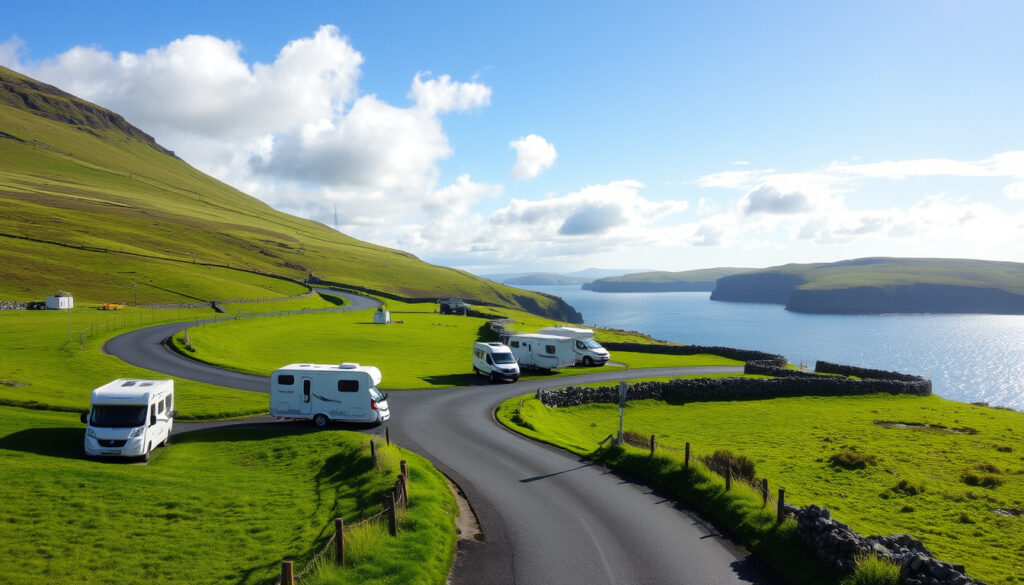
RV Parks Near Me: Ireland Campsites & Free Parking Guide
Ireland’s motorhome landscape is stricter than most continental neighbours — wild camping is broadly prohibited, yet a growing network of serviced sites, vetted stop apps, and surprisingly tolerant motorway service areas give travellers workable options once they know the rules.
Top RV Park Site: Pitchup.com · Ireland Camping Parks Listed: campingireland.ie · Kilkenny Family Park: Tree Grove · Blarney Park Rating: 4-star · Carlow Camping Reviews: TripAdvisor
Quick snapshot
- Ireland broadly prohibits widespread wild camping (Ireland.com)
- Serviced campervan sites are widely listed across directories (Pitchup)
- Safe Nights Ireland reports over 200 off-road parking locations for €15/year (Safe Nights Ireland)
- Exact lay-by rules vary by county and local byelaw enforcement
- Some grey-area overnight stops may be tolerated locally without formal permission
- No major legislative change pending — current guidance from Ireland.com remains the primary official reference
- The gap between demand for free stops and available serviced sites is driving growth in apps like Park4Night and Safe Nights Ireland
| Detail | Value |
|---|---|
| Key Directory | campingireland.ie |
| Kilkenny Park Name | Tree Grove |
| Blarney Distance | 8km from Cork |
| Carlow Reviews | TripAdvisor |
Can you park a motorhome anywhere in Ireland?
The short answer is no — and anyone who tells you otherwise is probably thinking of a different country. Ireland has no right-to-camp tradition like Norway or Scotland, and parking regulations are stricter than what many continental Europeans expect. According to official guidance from Tourism Ireland, motorhome travellers are encouraged to use serviced sites and should avoid farmland, beaches, and roadsides.
Legal restrictions on motorhome parking
Irish law treats overnight sleeping in a vehicle differently from simply parking it. A motorhome parked for a few hours in a car park may be fine; the same vehicle with someone asleep inside overnight may be deemed to be “camping” — a distinction that matters in many local authority areas. Public roads, lay-bys, and private car parks frequently carry signage that either explicitly prohibits overnight sleeping or implicitly discourages it through regular patrols.
There is no single national byelaw covering all motorhome overnight stops, which means rules can shift from one county to the next. What is tolerated in a rural Donegal lay-by may be explicitly forbidden in a Wicklow council car park.
Designated areas vs wild parking
Ireland’s approach to motorhome accommodation runs through official channels: Pitchup lists 22 bookable campgrounds in the Republic alone, and Stellplatz.info catalogues 145 motorhome pitches under the German-style “stellplatz” model. Discover Ireland, the official tourism platform run by Fáilte Ireland, profiles several parks including Roundwood Caravan and Camping Park in Wicklow — noted as the highest village in Ireland — and Streamstown Park in Roscrea, which offers a camper kitchen on a working dairy farm.
“Ireland is not a free-roaming motorhome paradise — wild camping carries real legal risk in most counties.”
Wild parking — pulling off the road and staying overnight without permission — exists in a legal grey zone. The landowner permission requirement is real, and the practical risk of a fixed penalty notice or a tow order is real in busy tourist corridors. That said, some remote coastal car parks see enough motorhome traffic that enforcement is rare.
The implication: Ireland is not a wild-camping destination in the Scandinavian sense, but it does offer a growing network of affordable, motorhome-friendly stops once you know where to look.
Where can you sleep in a campervan for free?
Free overnight options exist in Ireland, though they require more research than simply pitching up at the nearest petrol station. Several platforms aggregate locations, and a handful of specific stops are well-documented by campervan travellers who have used them.
Free spots in lay-bys and car parks
The most accessible free stops are motorway service areas — specifically Applegreen and Plaza locations — which offer 24-hour toilets, lighting, and shops without any overnight parking ban. The Tales of Tiny Boots, a blog covering Irish campervan routes, confirms these are widely used by the motorhome community precisely because they remove the uncertainty.
Beyond service areas, several documented free stops circulate in travel forums and apps. According to Goboony’s Irish motorhome guide, Horn Head near Dunfanaghy in Donegal (coordinates N 55.20419, W 7.95220) offers coastal parking with views, and Hook’s Lighthouse provides a spacious clifftop stop with toilet and cafe access nearby. St Mullins in Leinster (N 52.48777, W 6.92955) offers rural parking beside the River Barrow with swimming and walking access — a popular stop for those travelling the river corridor.
“These spots are not signposted as official motorhome stops and operate on a tacit tolerance rather than formal permission.”
— Goboony Irish motorhome guide
These spots are not signposted as official motorhome stops and operate on a tacit tolerance rather than formal permission. Conditions can deteriorate after wet weather, and some car parks install barriers or signage during peak season.
UK and Ireland options
For those combining an Irish trip with a UK crossing, the same app ecosystem works across both jurisdictions. Park4Night, widely recommended on campervan forums, filters by country and includes facilities data for Ireland — showing which stops have toilets, showers, and BBQ areas. Roadtrippers and Parkme offer broader parking coverage. Camping Ireland and Motorhome Parking Ireland provide Ireland-specific listings, though coverage is thinner outside major tourist routes.
Free stops exist, but they are concentrated in a handful of well-travelled locations. For anything beyond the obvious coastal lay-bys, a membership platform like Safe Nights Ireland (€15/year for 200+ locations) is worth considering — the annual fee pays for itself after two nights in a commercial campsite.
Can I sleep in my campervan in a car park?
This is one of the most common questions from first-time motorhome visitors, and the honest answer is: it depends entirely on the specific car park and who manages it.
Rules for public car parks
Local authority car parks in Ireland frequently prohibit overnight sleeping through traffic byelaws. Cork City Council, Dublin City Council, and most larger towns have signage stating “No overnight parking” or “No camping,” and enforcement ranges from passive to vigilant. Supermarket car parks operated by chains like Tesco or Dunnes Stores vary — some explicitly permit overnight parking, others rely on security patrols and cameras to discourage it.
The pattern in tourist-heavy areas: the more prominent the car park, the more likely it is monitored. Smaller rural car parks — particularly those at beaches, trails, or heritage sites — often see enough motorhome traffic that enforcement is impractical, but the absence of a ban does not mean permission has been granted.
Safety and ventilation tips
Irish advice on sleeping safely in a motorhome or campervan consistently emphasises ventilation. The old instruction to “crack a window” has a practical basis: condensation and condensation-related mould are genuine issues in Ireland’s damp climate, and carbon monoxide safety applies when any combustion appliance is running. Recommended practice includes running a low-level heating vent or leaving a rooflight partially open regardless of external temperature.
Do you have to crack a window when sleeping in your car?
Yes — opening a window or rooflight is standard safety practice in Ireland’s damp climate, even when temperatures drop. Condensation builds quickly in a sealed motorhome, leading to mould and moisture damage. More critically, any combustion appliance (heating, cooking) requires ventilation to prevent carbon monoxide accumulation. A gap of 2–5 cm in a window or roof vent maintains air exchange without significantly cooling the interior.
A 2024 update from several motorhome insurance and club sources notes that some roadside assistance policies now specify overnight stop duration limits — typically 24–48 hours for a “stopover” versus a “parking” — which aligns with how local authorities tend to interpret extended vehicle presence.
The catch: a car park stop is technically illegal if signage says so, but enforcement is highly uneven. The smart approach is to check the specific car park’s signage before settling in for the night — and to have an exit strategy.
Where is the best place to park an RV for free?
There is no single “best” free stop — the right choice depends on your route, your vehicle size, and how much convenience you need. That said, some categories of location consistently outperform others for motorhome travellers in Ireland.
Top free RV parking strategies
Strategy one: use the app network. Park4Night, with over 110,000 European locations indexed, gives the most reliable filterable results for Ireland. The platform’s crowd-sourced reviews mean you can check recent photos and notes before committing. Safe Nights Ireland takes a more curated approach — its 200+ Ireland locations are vetted for safety, and the membership includes access to both rural and urban Dublin stops that aren’t publicly listed.
Strategy two: follow the petrol station trail. Motorway service areas — Applegreen, Plaza, and to a lesser extent Circle K — are consistently motorhome-friendly and rarely patrolled for overnight stops. They lack the scenic appeal of a coastal clifftop, but they offer security cameras, toilets, and food options 24 hours.
Strategy three: research the heritage trail car parks. Several Failte Ireland-recommended driving routes have large roadside car parks at trailheads and heritage sites. These are generally tolerated for overnight stops precisely because the surrounding infrastructure (toilets, bins, signage) is already in place. The downside is that they can fill up quickly during the summer season.
Ireland-specific spots
Stellplatz.info, the German motorhome parking database, lists 145 Irish pitches including Hungry Hill Lodge & Campsite, which provides elevated views of the Beara Peninsula and serves as a departure point for some of Ireland’s finest walking trails. For families, Tree Grove near Kilkenny is described as a family-run park close to the city with strong TripAdvisor reviews. Blarney Caravan Park, rated 4-star and roughly 8km from Cork city, balances proximity to a major tourist attraction with a quieter setting.
“The critical rule across all free stop categories: avoid private land without explicit permission, and treat any signage that restricts overnight use as the final word.”
— CampingIreland.ie advisory
The critical rule across all free stop categories: avoid private land without explicit permission, and treat any signage that restricts overnight use as the final word. Ireland has no formal toleration doctrine in its traffic legislation, and a landowner complaint can quickly escalate to vehicle seizure in a rural area.
The trade-off: free stops give you flexibility but require more preparation. A serviced campsite gives you peace of mind, facilities, and legal certainty — at a cost that typically runs €20–35 per night for a motorhome pitch in Ireland.
Can I sleep in my motorhome in a layby?
This is the question that generates the most confusion, partly because the answer changes depending on which part of Ireland you’re in and how strictly local authorities are enforcing road regulations at any given time.
Lay-by regulations in Ireland and UK
In Ireland, a lay-by is typically part of the public road corridor, which means it falls under road traffic legislation rather than camping bylaws. Parking a motorhome in a lay-by for a short break is generally legal. Overnight sleeping — defined by some local authorities as presence between roughly midnight and 6am — is where the rule gets murky.
Several county councils have adopted specific motorhome byelaws in recent years, driven partly by complaints from residents in popular coastal areas about vehicles accumulating over successive nights. Wexford, Kerry, and Clare have been among the more active in this respect. The byelaws typically prohibit “camping or sleeping in a vehicle” on specific stretches of road or car park, and violations can attract a fixed penalty notice.
“County-level motorhome byelaws are expanding, not contracting. If you’re planning a route through Kerry or Clare in summer, check the relevant county council website for current restrictions before relying on a lay-by overnight stop.”
— Safe Nights Ireland route advisory
The UK model provides a useful contrast: many motorway service areas operate under a “24-hour maximum stay” without an explicit overnight sleeping ban, which has led to a clearer informal culture of lay-by tolerance. Ireland lacks this clarity, and the research notes suggest that even experienced motorhome travellers report inconsistent enforcement across adjacent counties.
Alternatives to lay-bys
If a lay-by stop carries too much legal uncertainty for your comfort, the practical alternatives in Ireland are: (1) use an app-filtered stop with recent positive reviews from other motorhome users; (2) join Safe Nights Ireland for access to its curated list of off-road locations; or (3) budget for a serviced campsite if you’re in a region where the byelaw situation is hostile.
County-level motorhome byelaws are expanding, not contracting. If you’re planning a route through Kerry or Clare in summer, check the relevant county council website for current restrictions before relying on a lay-by overnight stop.
What this means: the era of treating any roadside pull-in as a viable overnight option is effectively over in Ireland’s most visited regions. The apps and membership networks are filling the gap — but they require advance setup, unlike the spontaneous lay-by model that works in neighbouring countries.
What are the best RV parks near Dublin?
Dublin’s immediate vicinity has fewer dedicated motorhome pitches than you’d expect for a capital city, but the options that exist cover the range from basic to comfortable.
Pitchup flags several parks within an hour’s drive of Dublin city centre. The directory at campingireland.ie broadens the coverage, including smaller family-run parks that don’t always appear on international booking platforms. Safe Nights Ireland also lists urban Dublin locations that operate on a lower-key basis than commercial campgrounds.
The practical constraint for Dublin visitors: if you’re relying on free stops within the M50 orbital road, the options are limited and fills quickly on weekends. Booking ahead during the May–September season is strongly advisable if you want a guaranteed pitch near the city.
Upsides
- 22 bookable campgrounds in Republic of Ireland through Pitchup
- Safe Nights Ireland offers 200+ vetted off-road stops nationwide
- Motorway service areas provide reliable free overnight access
- Growing app ecosystem (Park4Night, Stellplatz.info) covers Ireland
- Family-run parks like Tree Grove offer local character beyond chains
Downsides
- Ireland broadly prohibits wild camping — no right-to-camp equivalent
- Lay-by overnight rules vary by county and are inconsistently enforced
- Dublin-area motorhome pitches are limited and book up fast in summer
- Free stops often lack facilities (toilets, showers, waste disposal)
- Some popular coastal car parks now have explicit overnight bans
How do caravan park prices compare in Ireland?
Irish campsite pricing covers a wide range, reflecting the diversity of facilities on offer. At the budget end, basic motorhome pitches at rural club sites can start around €12–15 per night for a tent or small van, with motorhome pitches typically running €18–25. Mid-range family parks with laundry, wifi, and a shop sit in the €22–30 band. Premium parks near major attractions — including the 4-star Blarney Caravan Park and several along the Wild Atlantic Way — can reach €35–45 for a fully-serviced pitch in peak season.
Seasonality matters significantly. Prices at most parks drop by 20–40% outside the May–September window, and many smaller parks operate on a honor-system or reduced-hours basis outside peak season. Weekday rates are consistently lower than weekend rates at parks near urban centres.
Static caravan parks Ireland
Static caravans — pre-erected holiday units rented by the week — operate across several parks in Ireland, particularly along the southeast coast and around Connemara. These are distinct from motorhome pitches and typically require advance booking through the park’s own website or a platform like Pitchup. Prices range from €400–900 per week in peak season depending on location and unit quality, with some parks offering year-round ownership options for those who want to leave a unit permanently sited.
The pattern: Irish campsite pricing is broadly comparable to the UK and northern Europe but tends to be cheaper than equivalent French or Dutch parks. The gap between rural and premium parks is significant — a family could spend €15 per night at a basic rural park or €40+ at a full-service coastal site, both with valid pitches.
Motorhome campsites southern Ireland map
The southern half of Ireland — covering counties Cork, Kerry, Clare, Limerick, Tipperary, and Waterford — contains the highest concentration of scenic motorhome pitches, partly because the Wild Atlantic Way route passes through the region and partly because several park operators have invested specifically in motorhome-friendly infrastructure.
Stellplatz.info maps individual motorhome pitches in the region with GPS coordinates, which is particularly useful for navigating rural locations without reliable mobile data. CampingIreland.ie provides a filterable directory by county. Key stops to look for include Hungry Hill Lodge & Campsite on the Beara Peninsula (a stellplatz favourite), several parks around Killarney that serve as gateways to the Ring of Kerry, and smaller operations along the Clare coastline near the Burren.
For southern Ireland specifically, the key practical consideration is road width. Many regional roads — particularly in Kerry and West Cork — were not designed for vehicles the size of a modern motorhome, and passing places can disappear precisely where you need them. Travellers in a large coach-built motorhome should check route feasibility on a mapping tool with vehicle dimension filters before committing to rural drives.
Best campsites in Ireland for families
Family-friendly camping in Ireland isn’t just about the pitch — it’s about what keeps children entertained when the weather turns, which in Ireland, it will. Several parks have specifically invested in family facilities that go beyond the basic hookup.
Discover Ireland (the official Fáilte Ireland platform) flags a handful of parks with standout family credentials. Lough Key Caravan and Camping Park in Roscommon offers a tree canopy walk and boating access that gives children a reason to put down the tablet. Streamstown Park in Roscrea runs a working dairy farm that doubles as an attraction — kids can watch milking and interact with animals, and the park’s camper kitchen means parents can cook without retreating inside on a rainy evening.
Tree Grove near Kilkenny is frequently mentioned in family camper reviews for its proximity to castles, rivers, and a town centre that children can explore on foot. Blarney Caravan Park, at 4-star and 8km from Cork, balances a major tourist draw (the Blarney Stone) with a quieter setting that parents rate for safety and space.
The practical tip for family motorhome trips in Ireland: pack for four seasons in one day. Irish campgrounds cope with this expectation routinely, and most parks have indoor play facilities as a baseline — but if you’re planning to cook, check whether the park has a proper covered kitchen area, not just an outdoor BBQ pad.
The implication: the best family parks in Ireland are the ones that have solved the weather problem — with covered indoor space, on-site activities, and a pitch layout that doesn’t require a three-layer waterproof system just to walk the dog.
Camper van holidays in Ireland?
Hiring a camper van for an Irish trip is increasingly accessible, with several rental companies operating from Dublin Airport and regional hubs. One-way hires between Dublin and Shannon or Kerry are possible with some operators, which opens up circular route options that avoid backtracking.
The domestic hire market has grown significantly since 2022, with both traditional rental firms and peer-to-peer platforms like Goboony adding Irish inventory. Prices for a week-long hire of a small campervan typically range from €600–1,100 outside peak season, rising to €1,200–1,800 in July and August. Insurance excess reduction — an add-on that brings the liability down from roughly €1,500 to €250–500 — is strongly recommended given the rural road conditions.
For those combining ferry travel with a rental, the Rosslare–Dublin or Holyhead–Dublin ferry corridors position you directly on Irish soil with a vehicle ready to go, cutting out the airport pickup logistics. Several Irish rental operators offer ferry-port collection as standard.
Frequently asked questions
What are caravan parks Ireland prices?
Irish motorhome pitches typically range from €18–25 at budget rural parks to €35–45 at premium serviced sites in peak season. Prices drop outside summer, and weekday rates are lower than weekend rates at parks near cities.
Best campsites in Ireland for families?
Tree Grove near Kilkenny, Blarney Caravan Park (4-star, 8km from Cork), Lough Key Caravan and Camping Park (tree canopy walk and boating), and Streamstown Park in Roscrea (camper kitchen on a dairy farm) are consistently recommended for family groups.
Motorhome campsites southern Ireland map?
Stellplatz.info maps 145 motorhome pitches in Ireland with GPS coordinates. campingireland.ie provides a county-by-county filter. The Beara Peninsula, Killarney area, and Clare coastline contain the highest concentration of scenic motorhome-specific pitches.
Campsites Kilkenny options?
Tree Grove is the most frequently cited family-run park in Kilkenny, near the city and well-reviewed on TripAdvisor. campingireland.ie lists additional options in the county, and Pitchup covers the broader Leinster region.
Static caravan parks Ireland?
Static caravan rental and ownership parks are available across the southeast coast and Connemara, with weekly peak-season rentals ranging from €400–900. Check Pitchup and individual park websites for availability.
RV parks near Dublin?
Options within an hour of Dublin include parks listed on Pitchup and campingireland.ie, plus the urban stops on Safe Nights Ireland. Dublin-adjacent pitches book up quickly in summer — reserve ahead during May–September.
Camper van holidays in Ireland?
Week-long campervan hire from Dublin typically costs €600–1,100 outside peak season, rising to €1,200–1,800 in summer. One-way hires between Dublin and Shannon or Kerry are available with select operators, enabling circular routes without backtracking.
Meer gerelateerde berichten
 Train from London to Paris: Costs, Times & Travel Guide
 Houston Rockets vs Milwaukee Bucks Match Player Stats: Nov 9 Box Score
 Water Heater Replacement Near Me: Costs, Signs & Lifespan Guide
 Ted Lasso Season 2: Plot, Cast, Episodes and Review
 Debt to Equity Ratio: Formula, Calculation & Interpretation
 Twilight New Moon – Plot, Cast, Book vs Movie Differences
 Good Shows to Watch: Top-Rated Series Right Now