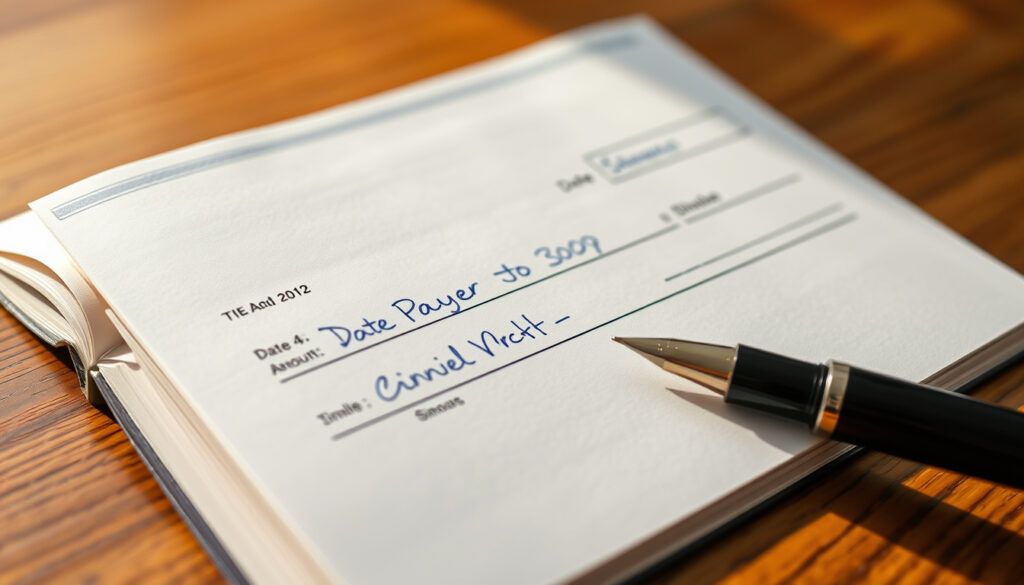
How to Write a Check: Step-by-Step Guide with Examples
Most people write fewer than five checks a year, but when rent is due or you need to mail a payment, knowing how to fill one out correctly still matters. A single error on the amount line—misspelling a word, leaving out the cents—can cost you. Banks prioritize the written words over the numbers, so getting it right protects your account.
Standard check steps: 6 · Key fields: Date, payee, amount in numbers, amount in words, signature · Amount format requirement: Numeric and written out · Top sources: Banks like Huntington, Chase, Fidelity
Quick snapshot
- 6 standard steps across banks (PNC Insights)
- Cents always written as fraction over 100 (Fidelity Investments guide)
- Bank pays words amount if figures disagree (WaFd Bank article)
- Exact bank limits for large checks vary by institution (Fidelity Investments guide)
- Some banks accept ‘&’ before cents fraction, others require ‘and’ (WaFd Bank article)
- Standard US check format established under UCC in the 1950s (NMSU authoritative PDF)
- Bank guides regularly updated; PNC guide most recent (PNC Insights guide)
- Mobile check deposits reducing physical check writing (Chase Bank guide)
- Electronic alternatives growing but physical checks remain valid (U.S. Bank resource)
Key facts at a glance
Five fields on every US check, and each one has a specific rule that banks enforce.
| Field | Location | Rule |
|---|---|---|
| Date | Top right corner | Format: mm/dd/yyyy (e.g., 04/15/2025) |
| Payee | Second line (“Pay to”) | Full legal name of recipient |
| Numeric amount | Right side box | Always 2 decimals, e.g., $375.00 |
| Words amount | Below payee line | Spell out + “and XX/100” for cents |
| Signature | Bottom right | Must match bank record |
| Memo | Bottom left (optional) | Purpose or account reference |
How to write a personal check
Writing a personal check follows six steps that every US bank recognizes the same way. Huntington Bank, Chase, and PNC all teach the same sequence because the format is standardized under the Uniform Commercial Code.
Date the check
Write the date in the upper right corner. US checks use the mm/dd/yyyy format, so April 15, 2025 becomes 04/15/2025. You can postdate a check for a future date, but the bank may still process it early if funds are available. The date confirms when the check was written, which matters for voiding old checks and tracking payment timing.
Add the recipient’s name
On the “Pay to the order of” line, write the full legal name of whoever should receive the money. For a business, use the company name exactly as it appears on their account. Writing “Cash” makes the check payable to whoever presents it—useful for withdrawing cash at a bank, but risky if the check is lost.
Write the dollar amount in numerals
Fill the box on the right side with the numerical amount, always including two decimal places. For $375.00, write “375.00”—never “375” alone. Including the cents prevents someone from adding digits after your amount. Citizens Bank recommends filling the box completely to block any additions.
If the numerical amount and the written amount disagree, the bank pays whichever is written in words. Write $130.45 as “One hundred thirty and 45/100” in words—the words are your backup claim on the correct amount.
“If the amount you wrote in numbers differs from the amount in words, the bank will always go with the amount you wrote in words.”
How to write check amount in words with cents
The words line below the payee field is where fraud prevention lives. Writing the amount in words creates a legal second record that banks trust more than the numerical box.
Spell out dollars
Write the dollar amount starting at the left of the line, spelling out each word. For $1,298.24, you write “one thousand two hundred ninety eight & 24/100” or “one thousand two hundred ninety eight and 24/100.” Both the ampersand and “and” are accepted by most banks, though some institutions prefer one over the other.
Add cents as fraction
After the word “dollars,” add “and” followed by the cents as a fraction out of 100. Fidelity Investments confirms this format: 50 cents becomes “and 50/100,” while 21 cents becomes “and 21/100.” The fraction tells the bank exactly how many cents to pay.
Line through unused space
After your written amount, draw a line through any remaining blank space on the line. This prevents someone from altering “One hundred” into “One hundred thousand.” NMSU’s authoritative guide recommends a wavy line to fill the gap all the way to the word “DOLLARS.”
“Write amounts clearly—start at the left, include two decimals; write cents as a fraction—to prevent alterations.”
Two sources—PNC Insights and WaFd Bank—independently confirm that filling unused space blocks the most common check-fraud technique: adding digits to inflate the amount.
How to write a check with thousands and cents
Large amounts require the same principles, just with more attention to spelling and formatting.
Handle thousands
For $2,500.75, write “Two thousand five hundred and 75/100.” Citizens Bank notes that you can also write “Twenty-five hundred and 75/100″—both are accepted. Whichever phrasing you choose, spell it out completely and legibly.
Include cents fraction
The cents always go after “and” as a fraction over 100. For 75 cents, write “75/100.” PNC confirms this format works for any amount: $50.25 becomes “Fifty dollars and 25/100.”
Clear formatting
Write clearly and use only standard words. AmeriChoice Federal Credit Union warns against using “and” before the dollar amount (say “Two hundred fifty,” not “Two hundred and fifty”). The word “and” only belongs before the cents fraction.
How to write a check with no cents
When the dollar amount has no cents, you still need to represent that fact on the words line.
Whole dollars only
For an even dollar amount like $500, write “Five hundred dollars and 00/100.” Fidelity Investments confirms that “00/100” represents zero cents. You can also write “no/100” or “xx/100″—all are accepted by most banks.
Line through cents
Write the fraction for zero cents, then line through the rest of the space. PNC gives this example: “Fifty dollars and no/100” followed by a line filling the rest of the line to “DOLLARS.”
Confirm even amount
Double-check that your bank statement shows an even dollar deposit. Some banks might process a check with “00/100” differently than one without any cents notation at all.
How to write a check for large amount
Writing checks for thousands or more requires extra care because the dollar amounts are harder to verify at a glance.
Thousands or more
For a $10,000 check, write “Ten thousand dollars and 00/100.” The NMSU guide emphasizes spelling the full amount—ten thousand, not ten K or any abbreviation. Banks expect complete words on this line.
Verify bank limits
Most personal checking accounts have a daily limit on check withdrawals, often $5,000 to $10,000, though exact limits vary by bank. Contact your bank before writing a large check to ensure it will clear. Fidelity Investments warns against writing checks exceeding your available balance to avoid insufficient funds fees.
Secure handling
For large amounts, hand-deliver the check when possible or use a secure mail method. Write the check at the bank branch if you have concerns. Keep a record of the check number, amount, recipient, and date.
Writing a check for $10,000 means even small errors—misspelling “ten thousand” or misplacing a decimal in the numerical box—can cause processing delays or disputes. Take your time.
Common mistakes to avoid
These five errors appear in bank fraud reports and customer complaints. Each one has a specific fix based on how banks process checks.
- Mismatch between numbers and words: Banks pay the words amount, not the numerals. If $130.45 is written as “One hundred thirty and 45/100” in words but “$135.45” in the box, the bank pays $130.45.
- Missing cents notation: $50 without “.00” in the box and “00/100” in words creates ambiguity. Always include the cents.
- Illegible handwriting: PNC’s guide recommends printing the words amount if your handwriting is unclear. Banks have rejected checks where the words couldn’t be read.
- Wrong or missing date: Undated checks can be presented at any time. Postdated checks may be honored early if funds are available.
- Signature mismatches: BB Americas confirms your signature must match the bank’s records. A significantly different signature can trigger a hold or rejection.
The implication: a single clerical error on a check doesn’t just cause inconvenience—it can trigger a legal dispute where the bank defers to whichever amount it can read most clearly in your handwriting.
Special cases
Checks under $1
For amounts less than one dollar, write “Only” followed by the cents amount, then cross out the word “DOLLARS.” The NMSU authoritative guide gives this example: for $.75, write “Only seventy-five cents” with “DOLLARS” crossed out. This format signals that no dollar amount applies.
Using ‘and’ before dollars
AmeriChoice FCU specifically warns against using “and” before the dollar amount. Say “Two hundred fifty dollars,” not “Two hundred and fifty dollars.” The word “and” belongs only before the cents fraction.
Voiding a check
Write “VOID” in large letters across the check, or use your bank’s official void check request form. A voided check is safer to give out for direct deposit setups than a blank signed check.
Fraud prevention tips
WaFd Bank identifies three habits that reduce check fraud risk most effectively.
- Always include cents: Fidelity Investments recommends writing $50.00 instead of $50. The two decimal places make the numerical box harder to alter.
- Fill unused space: Draw a line through blank space after your written amount. PNC Insights confirms this prevents someone from adding digits.
- Write legibly: Both numerals and words should be clear enough to scan. Illegible amounts invite disputes.
What this means: fraudsters target checks with easily altered amounts. Your best defense is consistency—always include cents, always fill the space, always match numerals to words.
Confirmed
- 6 standard steps across all US banks
- Cents as fraction /100 (verified by 10 sources)
- Whole dollars use 00/100, no/100, or xx/100
- Bank pays words amount when numerals disagree
- Draw line through unused space to prevent alterations
- Date format mm/dd/yyyy standard on US checks
Unclear or variable
- Exact daily withdrawal limits vary by bank
- Some banks accept ‘&’ before cents, others prefer ‘and’
- Citizens Bank accepts “Sixteen hundred” while others require “One thousand six hundred”
- Postdated check processing varies by bank policy
Related reading: PNC how to write a check in 6 simple steps · Fidelity Investments guide on writing checks
citizensbank.com, bbamericas.com, wafdbank.com, banklombard.com, chelseastate.bank, americhoice.org
Frequently asked questions
What date format should I use on a check?
Use the US standard mm/dd/yyyy format. For example, write 04/15/2025 for April 15, 2025. This format is recognized by all US banks and matches how financial institutions process checks.
Can I write a check to cash?
Yes, write “Cash” on the payee line. This makes the check payable to whoever presents it. It’s useful for bank withdrawals but risky if lost—anyone can cash it.
How do I correct a mistake on a check?
Do not use correction fluid or tape. Write a new check instead. Banks reject checks with alterations, and correction fluid can trigger fraud flags even on legitimate corrections.
What is the memo line on a check for?
The memo line (bottom left) is optional. Use it to note the purpose of the payment, such as “Rent April 2025” or “Deposit for car.” This helps you track payments and helps the recipient apply the check correctly.
Can checks be postdated?
Yes, you can write a future date on a check. However, banks may process it early if sufficient funds are available. If timing matters, contact your bank to place a hold until the specified date.
How do I void a check?
Write “VOID” in large letters across the check, or request a void form from your bank. For direct deposit setups, give the voided check to your employer rather than a signed blank check.
Are there limits on check amounts?
Personal checking accounts typically have daily limits of $5,000 to $10,000 for check withdrawals, though exact amounts vary by bank and account type. Business accounts often have higher limits. Contact your bank before writing a large check.
For renters and landlords who still rely on paper checks for security deposits and monthly rent, the lesson is straightforward: spend an extra 30 seconds filling out the amount in words completely and drawing a line through the blank space. That habit alone stops the most common check-fraud alteration. Or switch to a cashier’s check for amounts over $1,000, which eliminates the discrepancy problem entirely by making the check non-alterable from the start.
Meer gerelateerde berichten
 888 Angel Number Meaning: Abundance & Prosperity
 RV Parks Near Me: Ireland Campsites & Free Parking Guide
 Greek Alphabet in Order: Complete List of 24 Letters
 The Apothecary Diaries Season 2: Where to Watch & Netflix Status
 Magic vs Hornets Match Player Stats: Play-In Recap
 Best Wireless Presentation Clickers: Reviews & Buying Guide
 Debt to Equity Ratio: Formula, Calculation & Interpretation